
Showing posts with label ACW CONVERSIONS. Show all posts
Showing posts with label ACW CONVERSIONS. Show all posts
Friday, 30 March 2012


Monday, 19 September 2011
bucktails
 Pennsylvania played a key role during the Civil War.It was a state that had the most of the would be bleeding hearts of the republican dream.below is one of my early conversions, just add the bucktail.
 In reality they treated their free workers worse than the Southern slave. In the bucktail state you were free to die of fatique or hunger,
  thats what freedom was in the North.in short like the Neo Lib of present day the scum of the earth.below miniature minion bucktails
The industrial enterprise and natural resources were essential factors in the economic strength of the northern cause. The railroad system, iron and steel industry, and agricultural wealth were vital to the war effort.

The shipbuilders of Pennsylvania, led by the famous Cramp Yards, contributed to the strength of the navy and merchant marine, including the Civil War's first submarine, Alligator, was built at the Neafie & Levy Shipyard in 1861-1862. Thomas Scott, as Assistant Secretary of War, directed telegraph and railway services.
 Engineer Herman Haupt directed railroad movement of troops. Jay Cooke helped finance the Union cause, and Thaddeus Stevens was an important congressional leader.
Administration of military affairs during the war was directed by two Pennsylvanians: first by Simon Cameron, who resigned his seat in the U. S. Senate to become President Lincoln's first Secretary of War; he was succeeded by Edwin M. Stanton of Pittsburgh.
A total of 427,286 Pennsylvanians served in the Union forces, including 8,600 African-American volunteers. This number includes enlistees responding to President Lincoln's calls for Volunteers for the Union army, recruits, drafted men, substitutes, and recruits for the regular U. S. Army for a total of 362,284 men.  Adding the 25,000 Pennsylvania militia men who were called out in 1862, brings the grand total to 387,284 men, who served in 270 regiments and several detached companies of the Volunteer Army.
 Adding the 40,002 Pennsylvanians who enlisted in the United States Navy raises the total to 427,286.
Adding the 25,000 Pennsylvania militia men who were called out in 1862, brings the grand total to 387,284 men, who served in 270 regiments and several detached companies of the Volunteer Army. Adding the 40,002 Pennsylvanians who enlisted in the United States Navy raises the total to 427,286.
Three days after the Confederates fired on Fort Sumter, President Lincoln issued a proclamation calling out the militia of several States.
 abve is a boer rider from my collection but easily convertible as a reb or union irregular, its in metal.


Later that same day, Governor Andrew G. Curtin received a telegram from the Secretary of War requesting that Pennsylvania provide 16 regiments, and 2 regiments were wanted within 3 days.
 A sudden dash upon the Capital was strongly threatened, and the city was entirely unprotected. Five militia companies were called up and sent immediately to Washington. These companies later became known as "The First Defenders" because they were the first military units to reach the Nation's Capitol.
President Lincoln's initial call for 16 regiments of volunteers was answered by 25 regiments. In May 1861, the Assembly, at Governor Andrew G. Curtin's suggestion,
 created the Pennsylvania Reserve Corps of 15 regiments enlisted for three years' service. They were mustered into the Army of the Potomac after the first Battle of Bull Run
 , and thousands of other Pennsylvanians followed them. Camp Curtin at Harrisburg
 was one of the major troop concentration centers of the war. Admiral David D. Porter opened the Mississippi and Rear Admiral John A. Dahlgren made innovations in ordnance which greatly improved naval fire power.
  Army leaders from Pennsylvania were numerous and able, including such outstanding officers as George B. McClellan, George G. Meade, John F. Reynolds, Winfield S. Hancock, Andrew A. Humphreys, John White Geary, David McMurtrie Gregg, and John F. Hartranft.
Pennsylvania had forty-eight general officers and fourteen commanders of armies and corps, namely: George Gordon Meade, (below another Conversion of mine)
 George B. McClellan, Winfield Scott Hancock, John F. Reynolds, Andrew A. Humphreys, David B. Birney, John Gibbon, John Grubb Parke, Henry Morris Naglee, Charles Franklin Smith, Goerge Cadwalader, Samuel G. Crawford, Samuel Peter Heintzelman, and William Buel Franklin.
  Generals David McMurtrie Gregg and Benjamin H. Grierson were distinguished cavalry commanders, Washington L. Elliott was chief of cavalry in the Army of the Cumberland, and commanded a department.
  Admiral David D. Porter, the heroic naval commander, was a native of Chester. Galusha Pennypacker, of Chester County, was the youngest general in either army during the war.
  Born June 1, 1844, he was only 20 when appointed Brevet Brigadier General U. S. Volunteers on January 15, 1865; Brigadier General U. S. Volunteers on February 18, 1865;
 and Brevet Major General U. S. Volunteers on March 13, 1865. He led the assault on Fort Fisher and was wounded seven times in eight months.
Private Richard Montgomery of the 155th Pennsylvania Volunteers was the last enlisted man killed in the fighting in Virginia.
 He was killed at Farmville, on the morning of April 9, 1865, shortly before General Robert E. Lee surrendered his Army of Northern Virginia to Lt. General Ulysses S. Grant.
Oliver Wilcox Norton of the 83rd Pennsylvania Volunteers, a Brigade bugler, assisted General Daniel Butterfield modify the Infantry bugle call for Lights Out, thereby creating the hauntingly beautiful "Taps".

Pvt. William Henry Christman, Company G, 67th Pennsylvania Infantry, was the first military service man interred in Arlington National Cemetery on May 13, 1864. Pvt. William Blatt, 49th Pennsylvania Infantry, was the first battle casualty interred at Arlington on Saturday, May 14, 1864.
 Pvt. William H. McKinney, age 17, of the 17th Pennsylvania Cavalry was also interred on Friday, May 13, 1864. He was the first soldier to have family present at his funeral.
Seven commissioned officers of Company C of the 148th Pennsylvania Volunteers were killed in the line of duty---more than any other company in the Union Army.

The 6th United States Colored Troops, recruited in Pennsylvania and trained at Camp William Penn, lost 62 percent of its men during an assault on New Market Heights near Richmond in 1864. Two of its members received the Medal of Honor for gallantry.*The 13th Pennsylvania Reserves, the "Bucktail Regiment,"was recruited in the timbering counties of northwestern Pennsylvania. The Bucktails sported white-tailed deer tails on their caps as a symbol of their skilled markmanship.*most of the models here are my creations or my painted jobs, some conversions and some fuck ups like the starlux rider
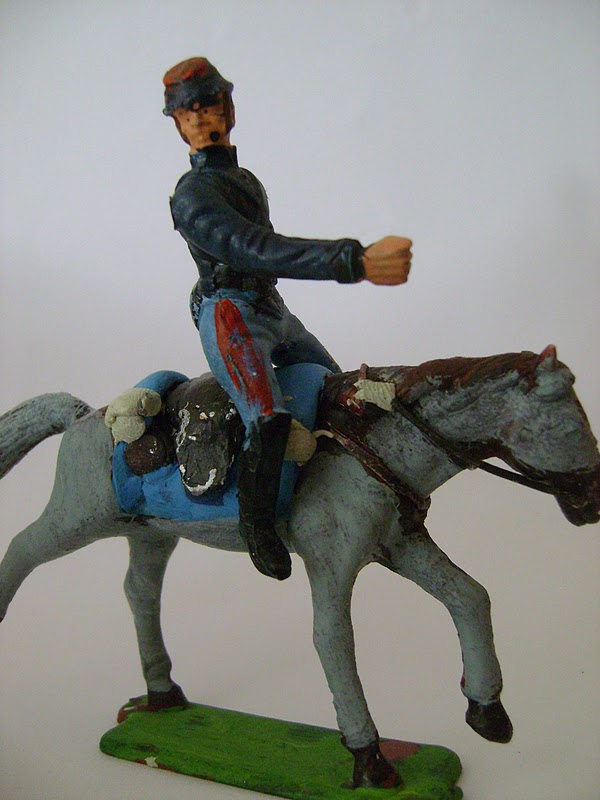
In the western theater, the 9th Pennsylvania Cavalry, assigned to the Army of the Cumberland, was the only eastern cavalry participating in Sherman's March to the Sea.

Monday, 5 September 2011
georgia brigade

 On April 11, 1863, Brigadier General John Brown Gordon, previously Colonel of the 6th Alabama, assumed temporary command of the Georgia Brigade from Colonel Clement A. Evans of the 31st Georgia. Gordon had been named a Brigadier in November 1, 1862 on Lee's recommendation after his heroic service at Sharpsburg (Antietam) where he sustained five wounds. He was not confirmed in his new rank until May 11, 1863 (with the promotion made retroactive to May 7), after the Battle of Chancellorsville, and was assigned permanent command of the Georgia Brigade shortly thereafter following a unanimous petition by its regimental officers to General Lee.
A "comparative stranger" to his new brigade, Gordon was to make quite an impression in the days that followed. Private G. W. Nichols of the 61st Georgia wrote that:
We were soon all acquainted with him. He put the company and regimental commanders to work drilling the boys. We often had three drills daily; first, company drill; then, battalion drill; and in the afternoon brigade drill. Gordon would ride along the line, talk very kind, yet very positive, and the officers and men were soon liking him very much.The end of April found the Georgia brigade still posted in their winter encampments along with the rest of Lee's 60,000 man Confederate Army of Northern Virginia guarding defensive lines overlooking Fredericksburg and the west bank of the Rappahannock River. The 130,000 man Union Army of the Potomac under new commander "Fighting Joe" Hooker was positioned across the river to the east.
The 31st Georgia was encamped to the south covering the crossing at Port Royal. The rest of the brigade was posted with General Early's division along the line of the Richmond, Fredericksburg & Potomac Railroad between Deep Run and Hamilton's Crossing. Their camps were in the low foothills paralleled the Military Road with pickets advanced forward to the River Road [a.k.a the Richmond Stage Road] where they could cover the crossings south of the town. This was ground over which the Georgians had fought the previous December, launching the counterattack that repulsed the advance of General George Meade's Union division during Ambrose Burnside's disasterous first battle of Fredericksburg.
Tuesday, 2 August 2011
New metal sword on original herald figure
 This figure had a broken sword so I gave him a new metal one. photo was with sony cybershot by myself as in me.
Friday, 8 May 2009
ITALIAN BERSAGLIERI AND ACW CONVERSIONS


 A new conversion I'm working on .ACW ITALARI into Bersagleri
 Replicants Conversion
A Replicants and a BMC conversion
 Herald conversion
 BMC and Replicants
Subscribe to:
Posts (Atom)