
Thursday, 9 February 2012


Wednesday, 8 February 2012
Vera cruz
 The city of Veracruz is a major port city and municipality on the Gulf of Mexico in the Mexican state of Veracruz. The city is located in the central part of the state. It is located 90 km (56 mi) along Federal Highway 140 from the state capital Xalapa, and is the state's most populous city. The city's population is actually greater than the municipality's population, since part of the city extends into neighboring Boca del Río Municipality.
 At the 2010 census there were 554,830 inhabitants total, 428,323 in Veracruz Municipality and 126,507 in Boca del Río Municipality.[Veracruz is Mexico’s oldest and largest port and the port most connected with its history.
Hernán Cortés arrived to Mexico here in 1519, founding the city with the name of Villa Rica de la Vera Cruz, due to the area’s gold and because they landed on Good Friday. This settlement became the first on the American mainland and the first to receive a coat-of-arms. During the colonial period, this city had the largest mercantile class and at times was richer than Mexico City. This wealth made it attractive to pirates, against which fortifications such as Fort San Juan de Ulúa were built. In the 19th century, Veracruz saw a number of invasions, mostly by France and the United States with the last invasion occurring in 1914. For much of the 20th century, the production of petroleum was more important for the state,but in the latter twentieth century and into the twenty-first, the port has re-emerged as the main economic engine, becoming the main port for most of Mexico’s imports and exports, especially for the automotive industry.
Veracruz’s status as a port has made the city a blend of cultures, mostly indigenous, Spanish and Afro-Cuban. The influence of these three is best seen in the food and music of the area, which has strong Spanish, Caribbean and African influences The Battle of Veracruz was a 20-day siege of the key Mexican beachhead seaport of Veracruz, during the Mexican-American War.
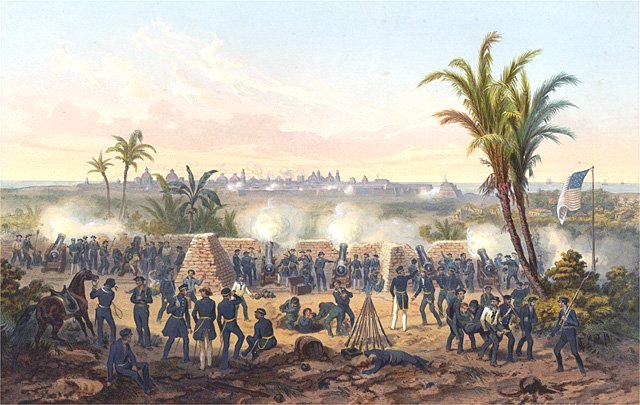 Lasting from 9-29 March 1847, it began with the first large-scale amphibious assault conducted by United States military forces, and ended with the surrender and occupation of the city. U.S. forces then marched inland to Mexico City.
 After the battles of Monterrey
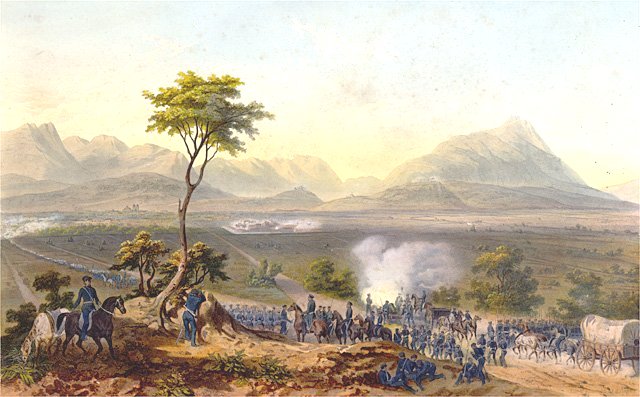 and Buena Vista,
 fighting in northern Mexico subsided. Much of Zachary Taylor's Army of Occupation
  was transferred to the command of Major General Winfield Scott
  after the battle of Monterrey. After deliberating on the next course of action,
 Scott and other Washington officials came to the agreement that a landing would be made at Veracruz, which would provide the Americans a point for a further advance inland.
 Mexican military intelligence knew in advance of U.S. plans to attack Veracruz, but internal government turmoil left them powerless to send crucial reinforcements before the American assault commenced.
Vera Cruz is a 1954 American Technicolor Western starring Gary Cooper and Burt Lancaster
 , about the French intervention in Mexico and the use of american mercenaries and it also featured Denise Darcel
.jpg) , Sara Montiel
, Sara Montiel , and Cesar Romero
 . The movie was directed by Robert Aldrich from a story by Borden Chase. The film's amoral characters and cynical attitude toward violence .- there is a big battle between the american mercenaries and french lancers.(including a scene where
  Lancaster's character threatens to murder child hostages) were considered shocking at the time and influenced future Westerns such as The Magnificent Seven,
 The Wild Bunch, and the films of Sergio Leone.
Another film featuring the intervention was Major Dundee where Charlton Heston leads a band of mixed military over the border to chase Apaches only to end up embroiled in the war.Above is Richard Harris.Senta Berger was the romance angle.
 The French intervention in Mexico also known as The Maximilian Affair, War of the French Intervention, and The Franco-Mexican War, was an invasion of Mexico by an expeditionary force sent by the Second French Empire
 , supported in the beginning by the United Kingdom and the Kingdom of Spain. It followedPresident Benito Juárez's
  suspension of interest payments to foreign countries on 17 July 1861, which angered Mexico's major creditors: Spain, France and Britain.
Napoleon III of France was the instigator. His foreign policy was based on a commitment to free trade. For him, a friendly government in Mexico provided an opportunity to expand free trade by ensuring European access to important markets, and preventing monopoly by the United States. Napoleon also needed the silver that could be mined in Mexico to finance his empire. Napoleon built a coalition with Spain and Britain at a time the U.S. was engaged in a full-scale civil war. The U.S. protested but could not intervene directly until its civil war was over in 1865.
The three powers signed the Treaty of London on October 31, to unite their efforts to receive payments from Mexico. On 8 December the Spanish fleet and troops from Spanish-controlled Cuba arrived at Mexico's main Gulf port, Veracruz. When the British and Spanish discovered that the French planned to invade Mexico, they withdrew.
The subsequent French invasion resulted in the Second Mexican Empire, which was supported by the Roman Catholic clergy, many conservative elements of the upper class, and some indigenous  communities; when the presidential terms of Benito Juárez (1858–71) were interrupted by the rule of the Habsburg monarchy in Mexico (1864–67). Conservatives, and many in theMexican nobility, tried to revive the monarchical form of government (see: First Mexican Empire)
  when they helped to bring to Mexico an archduke from the Royal House of Austria, Maximilian Ferdinand, or Maximilian I of Mexico .photos of french troops from blog pauly wauly, great blog to check out
 (who married Charlotte of Belgium, also known as Carlota of Mexico), with the military support of France.
France had various interests in this Mexican affair, such as seeking reconciliation with Austria, which had been defeated during the Franco-Austrian War, counterbalancing the growing U.S. power by developing a powerful Catholic neighbouring empire, and exploiting the rich mines in the north-west of the country.
Tuesday, 7 February 2012


dickens and london
What remains of the London that Dickens knew? Not much. The characters are gone and the life-breath of what gave them reason does not exist anymore. .
London is more or less still Victorian if we consider the buildings, above is my house in London and if you live in a typical London house left over from the Victorian period then you will obviously understand that time much more.As someone said "The past is still with us in ;London just look around".
The man who made Victorian London live was Dickens. . Maybe without Dickens we'd be left solely with what remains, the architecture.
Writers and critics tend to think that Dickens had an incredible imagination as regards his characters but when asked if he imagined and invented his characters he replied "All my characters are people I actually met" .
This is obvious if we consider that unlike today London was a city where "ways to be" or to think were not forthcoming as with the television/publicity generation of today where most ideas and reasons to be are "second hand".thye point is thatr media "role models" didn't exist so what seems to us far fetched today as regards the writers characters was simply the norm then.
There are many who try to intellectualise Dickens into more than what he was but the most important thing is to realise that he was first and foremost a great writer of observation. He wrote about London because that was what he knew and was expert on and it wasn't really a choice.
At the same time as Dickens there was Karl Marx.
Basically Marx was the moral counterpart to Dickens as the real Marxist is to the Neo-Lib today. Like the Neo Lib do gooder of today Dickens sought to highlight injustice but didn't know what the real cause was. Marx on the other hand understood the cause of economic misery. Dickens knew the suffering but not the cause. The cause was that workers were basically slaves to capitalists. Marx said "When England was the wonder of the world it was also the workhouse of the world". Marx added that the American slave in the cotton states of America was healthier and fitter than a "free" Londoner in the Rookery
From Thomas Beames The Rookeries of London (1850): "…the worst sink of iniquity was The Rookery, a place or rather district, so named, whose shape was triangular, bounded by Bainbridge Street, George Street and High Street, St Giles… the colony, called The Rookery, was like an honeycomb, perforated by a number of courts and blind alleys, cul de sac, without any outlet other than the entrance. Here were the lowest lodging houses in London, inhabited by the various classes of thieves common to large cities… were banded together… Because all are taken in who can pay their footing, the thief and the prostitute are harboured among those who only crime is poverty, and there is thus always a comparatively secure retreat for him who has outraged his country's laws. Sums here are paid, a tithe of which, if well laid out, would provide at once a decent and an ample lodging for the deserving poor; and that surplus,which might add to the comfort and better the condition of the industrious, finds its way into the pocket of the middleman…"
London's poor tried to scrape a living doing jobs which one can only imagine the Devil himself thought up. River Men made their living from fishing from drowned bodies, and Scavangers searched the sewers and rubbish tips for coins or rope to sell on. London's docks expanded rapidly. Smaller boats, mainly carrying cargoes such as coal and grain from other British ports, still used riverside wharves, but congestion on the Thames was such that purpose-built docks were needed to handle the big ocean-going vessels. Whole new villages and communities grew up to serve the docks, but poverty was endemic because the wages were extremely low.
London became an increasingly stratified city, with a relatively prosperous West End and a poor East End.
Model dwellings to house the poor began to appear - the American philanthropist, George Peabody, left substantial funds for their construction - but never enough to make any serious dent in the growing problem of the slums. In workhouses, families were split up and made to wear drab clothing deliberately intended to destroy individuality. A standard workhouse haircut also made them instantly recognizable if they went out in public. Inside they worked pointlessly at stone-breaking and oakum-picking. The situation gave rise to many philanthropic initiatives, such as the founding in 1878 of William Booth's Salvation Army, which set up soup kitchens and hospitals to help the very poor. Ultimately, the extreme poverty in London was to have massive and worldwide repercussions: Karl Marx's observations on its causes and solutions were to become the basis for Communist-inspired revolutions in several parts of the world. Marx understood the link between work and profit and spent most of his days in the British museum reading room building up his theories on what he thought would without doubt become a world revolution.Dickens on the other hand had little idea of what would be the result of people living in absolute poverty in the city of London.
The Britain that Marx was exiled to was the US of its day. The Union Jack already flew over a large part of the world, and during Marx’s lifetime more colonies would be conquered. British capitalism was the power of the world’s first great globalisation.
The world’s goods were increasingly carried in British ships. World finance was centred on the City of London and what Disraeli, the Tory politician, called its “mighty loan managers, on whose fiat the fate of kings and empires sometimes depend”. And if economic power was not enough, British capitalism could always depend on the Royal Navy to open up routes for trade.
Britain was also changing within. The 1851 census recorded that 51 percent now lived in the towns. No other major economy would achieve this before the 20th century. London was the world’s greatest city, with a population of 3.8 million by 1881. In the countryside the peasantry had all but disappeared. Aristocrats owned the land and rented it to farmers.
But the landowners were themselves capitalists. They developed their properties for profit. The dukes of Bedford, Norfolk and Westminster earned huge rents from the areas of London that Marx walked around.
Even if they still used ancient titles and enjoyed fancy dress, they merged with the lords of finance and industry to create a ruling class that was united.
But if capitalism allowed the accumulation of wealth that Marx analysed in Capital, it also brought misery, some of which he experienced. In its first years in the capital the Marx family lived a life of “bourgeois misery” in lodgings in Dean Street, Soho.
London concentrated not only wealth but poverty and degradation. There were said to be 3,000 brothels in metropolitan London at this time.London Brothels could give satisfaction to nearly any perversion a French visitor said.
There were many times when the Marx family was reduced to living on bread and potatoes. “I live in pawn,” Marx said. It was only help from Engels in Manchester that enabled them to survive.Engels was the owner of a factrory but syupported the ideas of Marx.
Even so it was a life of ill health, the death of children and low morale until they finally managed to escape to HampsteadH in north London in 1856. Yet his personal troubles still continued. His wife, Jenny, had a stillborn child, and later she caught smallpox.
They would also have to deal with what happened as capitalism in Britain and other countries shifted towards monopoly and state intervention. These were possibilities he wrote about, but only after his death would the trends become clearer.
There is another dimension to Marx’s time in London—his contact with the working class. Some accounts minimise this, making Marx an academic seeing the world from the British Museum. But no serious socialist develops that way.
Engels led the way in 1843 when he not only observed factory conditions in the north but made contact with radical Chartists. Engels dedicated his book on the condition of the working class “to the working classes of Great Britain”.
Reading it, Marx saw a description of the working class as a political force the like of which he had not yet met in Germany or France.
In Europe before 1848, movements of protest drew on artisan and craft workers. But in Britain the working class movement was different. It drew on large numbers of factory workers who barely existed in the rest of Europe.
The potential power of these “first born sons of modern industry” could be seen in the 1840s in their support for the Chartist movement for working class political rights.
But it could also be seen in the world’s first general strike in 1842, and it could be seen in their fight for union rights. The British trade unions in the 1840s were better organised than trade unions in the rest of Europe.
Marx first briefly visited London and Manchester with Engels in 1845, and made contact with the Chartists. When he returned in 1849 there were new contacts, and in 1850 The Communist Manifesto was published in English in the Red Republican newspaper.
Marx’s direct links with the British working class movement weakened in the 1850s. They grew again in the 1860s when he became secretary of the First International.
These more engaged years were the context for major developments in his political analysis. Here we find Marx thinking through issues like that of racism, as he considered the anti-Irish culture that existed in parts of the working class. Here too in 1871, when defending the Paris Commune, he saw that socialism could not just be about seizing state power. Workers had to make it for themselves.
Even the completion of the first volume of Capital in 1867 reflected the greater urgency of these years of more active engagement.
Theory does not thrive on air, least of all the air of the British Museum. Liebknecht was right—it was in Britain and London that Marx found the “bricks and mortar” for his work.
ere Marx found what he was looking for, what he needed,” said the German socialist Wilhelm Liebknecht. “The bricks and mortar for his work Capital, which could only have been written in London.”
London is more or less still Victorian if we consider the buildings, above is my house in London and if you live in a typical London house left over from the Victorian period then you will obviously understand that time much more.As someone said "The past is still with us in ;London just look around".
The man who made Victorian London live was Dickens. . Maybe without Dickens we'd be left solely with what remains, the architecture.
Writers and critics tend to think that Dickens had an incredible imagination as regards his characters but when asked if he imagined and invented his characters he replied "All my characters are people I actually met" .
This is obvious if we consider that unlike today London was a city where "ways to be" or to think were not forthcoming as with the television/publicity generation of today where most ideas and reasons to be are "second hand".thye point is thatr media "role models" didn't exist so what seems to us far fetched today as regards the writers characters was simply the norm then.
There are many who try to intellectualise Dickens into more than what he was but the most important thing is to realise that he was first and foremost a great writer of observation. He wrote about London because that was what he knew and was expert on and it wasn't really a choice.
At the same time as Dickens there was Karl Marx.
Basically Marx was the moral counterpart to Dickens as the real Marxist is to the Neo-Lib today. Like the Neo Lib do gooder of today Dickens sought to highlight injustice but didn't know what the real cause was. Marx on the other hand understood the cause of economic misery. Dickens knew the suffering but not the cause. The cause was that workers were basically slaves to capitalists. Marx said "When England was the wonder of the world it was also the workhouse of the world". Marx added that the American slave in the cotton states of America was healthier and fitter than a "free" Londoner in the Rookery
From Thomas Beames The Rookeries of London (1850): "…the worst sink of iniquity was The Rookery, a place or rather district, so named, whose shape was triangular, bounded by Bainbridge Street, George Street and High Street, St Giles… the colony, called The Rookery, was like an honeycomb, perforated by a number of courts and blind alleys, cul de sac, without any outlet other than the entrance. Here were the lowest lodging houses in London, inhabited by the various classes of thieves common to large cities… were banded together… Because all are taken in who can pay their footing, the thief and the prostitute are harboured among those who only crime is poverty, and there is thus always a comparatively secure retreat for him who has outraged his country's laws. Sums here are paid, a tithe of which, if well laid out, would provide at once a decent and an ample lodging for the deserving poor; and that surplus,which might add to the comfort and better the condition of the industrious, finds its way into the pocket of the middleman…"
London's poor tried to scrape a living doing jobs which one can only imagine the Devil himself thought up. River Men made their living from fishing from drowned bodies, and Scavangers searched the sewers and rubbish tips for coins or rope to sell on. London's docks expanded rapidly. Smaller boats, mainly carrying cargoes such as coal and grain from other British ports, still used riverside wharves, but congestion on the Thames was such that purpose-built docks were needed to handle the big ocean-going vessels. Whole new villages and communities grew up to serve the docks, but poverty was endemic because the wages were extremely low.
London became an increasingly stratified city, with a relatively prosperous West End and a poor East End.
Model dwellings to house the poor began to appear - the American philanthropist, George Peabody, left substantial funds for their construction - but never enough to make any serious dent in the growing problem of the slums. In workhouses, families were split up and made to wear drab clothing deliberately intended to destroy individuality. A standard workhouse haircut also made them instantly recognizable if they went out in public. Inside they worked pointlessly at stone-breaking and oakum-picking. The situation gave rise to many philanthropic initiatives, such as the founding in 1878 of William Booth's Salvation Army, which set up soup kitchens and hospitals to help the very poor. Ultimately, the extreme poverty in London was to have massive and worldwide repercussions: Karl Marx's observations on its causes and solutions were to become the basis for Communist-inspired revolutions in several parts of the world. Marx understood the link between work and profit and spent most of his days in the British museum reading room building up his theories on what he thought would without doubt become a world revolution.Dickens on the other hand had little idea of what would be the result of people living in absolute poverty in the city of London.
The Britain that Marx was exiled to was the US of its day. The Union Jack already flew over a large part of the world, and during Marx’s lifetime more colonies would be conquered. British capitalism was the power of the world’s first great globalisation.
The world’s goods were increasingly carried in British ships. World finance was centred on the City of London and what Disraeli, the Tory politician, called its “mighty loan managers, on whose fiat the fate of kings and empires sometimes depend”. And if economic power was not enough, British capitalism could always depend on the Royal Navy to open up routes for trade.
Britain was also changing within. The 1851 census recorded that 51 percent now lived in the towns. No other major economy would achieve this before the 20th century. London was the world’s greatest city, with a population of 3.8 million by 1881. In the countryside the peasantry had all but disappeared. Aristocrats owned the land and rented it to farmers.
But the landowners were themselves capitalists. They developed their properties for profit. The dukes of Bedford, Norfolk and Westminster earned huge rents from the areas of London that Marx walked around.
Even if they still used ancient titles and enjoyed fancy dress, they merged with the lords of finance and industry to create a ruling class that was united.
But if capitalism allowed the accumulation of wealth that Marx analysed in Capital, it also brought misery, some of which he experienced. In its first years in the capital the Marx family lived a life of “bourgeois misery” in lodgings in Dean Street, Soho.
London concentrated not only wealth but poverty and degradation. There were said to be 3,000 brothels in metropolitan London at this time.London Brothels could give satisfaction to nearly any perversion a French visitor said.
There were many times when the Marx family was reduced to living on bread and potatoes. “I live in pawn,” Marx said. It was only help from Engels in Manchester that enabled them to survive.Engels was the owner of a factrory but syupported the ideas of Marx.
Even so it was a life of ill health, the death of children and low morale until they finally managed to escape to HampsteadH in north London in 1856. Yet his personal troubles still continued. His wife, Jenny, had a stillborn child, and later she caught smallpox.
They would also have to deal with what happened as capitalism in Britain and other countries shifted towards monopoly and state intervention. These were possibilities he wrote about, but only after his death would the trends become clearer.
There is another dimension to Marx’s time in London—his contact with the working class. Some accounts minimise this, making Marx an academic seeing the world from the British Museum. But no serious socialist develops that way.
Engels led the way in 1843 when he not only observed factory conditions in the north but made contact with radical Chartists. Engels dedicated his book on the condition of the working class “to the working classes of Great Britain”.
Reading it, Marx saw a description of the working class as a political force the like of which he had not yet met in Germany or France.
In Europe before 1848, movements of protest drew on artisan and craft workers. But in Britain the working class movement was different. It drew on large numbers of factory workers who barely existed in the rest of Europe.
The potential power of these “first born sons of modern industry” could be seen in the 1840s in their support for the Chartist movement for working class political rights.
But it could also be seen in the world’s first general strike in 1842, and it could be seen in their fight for union rights. The British trade unions in the 1840s were better organised than trade unions in the rest of Europe.
Marx first briefly visited London and Manchester with Engels in 1845, and made contact with the Chartists. When he returned in 1849 there were new contacts, and in 1850 The Communist Manifesto was published in English in the Red Republican newspaper.
Marx’s direct links with the British working class movement weakened in the 1850s. They grew again in the 1860s when he became secretary of the First International.
These more engaged years were the context for major developments in his political analysis. Here we find Marx thinking through issues like that of racism, as he considered the anti-Irish culture that existed in parts of the working class. Here too in 1871, when defending the Paris Commune, he saw that socialism could not just be about seizing state power. Workers had to make it for themselves.
Even the completion of the first volume of Capital in 1867 reflected the greater urgency of these years of more active engagement.
Theory does not thrive on air, least of all the air of the British Museum. Liebknecht was right—it was in Britain and London that Marx found the “bricks and mortar” for his work.
ere Marx found what he was looking for, what he needed,” said the German socialist Wilhelm Liebknecht. “The bricks and mortar for his work Capital, which could only have been written in London.”
Monday, 6 February 2012
leopold lll

Leopold III ( 3 November 1901 – 25 September 1983) reigned as King of the Belgians from 1934 until 1951, when he abdicated in favour of the Heir Apparent, his son Baudouin.
Leopold III was born in Brussels as Prince Leopold of Belgium, Prince of Saxe-Coburg and Gotha, and succeeded to the throne of Belgium on 23 February 1934 following the death of his father, King Albert I.
He was invested as the 1,154th Knight of the Order of the Golden Fleece in Spain in 1923, the 355th Grand Cross of the Order of the Tower and Sword in 1927 and the 833rd Knight of the Order of the Garter in 1935.
When World War II broke out in September 1939, the French and British governments immediately sought to persuade Belgium to join them. Leopold and his government refused, maintaining Belgium's neutrality. Belgium considered itself well-prepared against a possible invasion by Axis forces, for during the 1930s Leopold had made extensive preparations against an invasion of his country, historically a battlefield in wars between French and Germans.
On 10 May 1940 the German army invaded Belgium. On the first day of the offensive the Belgian fortifications were penetrated before any French or British troops could arrive and the country was overwhelmed by the numerically superior Germans.Many Belgians just run away in reality.
Nevertheless, the Belgian perseverance prevented the British Expeditionary Force from being outflanked and cut off from the coast, enabling the evacuation from Dunkirk. After his military surrender Leopold stayed on in Brussels to face the victorious invaders, while his entire civil government fled to Paris and later to London.
Sunday, 5 February 2012


Saturday, 4 February 2012

Tuesday, 31 January 2012


Monday, 30 January 2012

Sunday, 29 January 2012
bazooker by atlantic

 of rocket propelled anti-tank weapons used in infantry combat. Featuring a solid rocket motor for propulsion, it allowed for high-explosive anti-tank (HEAT) warheads to be delivered against armored vehicles, machine
  gun nests, and fortified bunkers at ranges beyond that of a standard thrown grenade or mine. The universally-applied nickname arose from the M1 variant's vague resemblance to the musical instrument called a
  "bazooka" invented and popularized by 1930s by U.S. comedian Bob Burns.
During World War II, German armed forces captured several bazookas in early North African encounters and soon reverse engineered their own version, increasing the warhead diameter to 8.8 cm (amongst other
 minor changes) and widely issuing it as the Raketenpanzerbüchse "Panzerschreck" ("Tank terror")
 .
.Due to the novelty and easy recognition of the name, the term "bazooka" continues to be used informally as a genericized term to refer to any shoulder-fired missile weapon

Subscribe to:
Posts (Atom)