
Tuesday, 17 May 2011


marie by mokarex

Marie Antoinette was born in Austria, a daughter of Francis I, Holy Roman Emperor, and Austrian Empress Maria Theresa. She was born on the same day as the famous earthquake of Lisbon.
As with most royal daughters, Marie Antoinette was promised in marriage in order build a diplomatic alliance between her birth family and the family of her husband. Marie Antoinette married the French dauphin, Louis, grandson of Louis XV of France, in 1770. He ascended the throne in 1774 as Louis XVI.
Marie Antoinette was welcomed in France at first. Her frivolity contrasted with the withdrawn personality of her husband. After her mother died in 1780, she became more extravagant and this led to growing resentment. The French were suspicious of her ties to Austria and her influence on the King in attempting to foster policies friendly to Austria.
Marie Antoinette, formerly welcomed, now was vilified for her spending habits and opposition to reforms. The 1785-86 Affair of the Diamond Necklace, a scandal in which she was accused of having an affair with a cardinal in order to obtain a costly diamond necklace, further discredited her and reflected on the monarchy.
After an initial slow start at the expected role of childbearer -- her husband apparently had to be coached in his role in this -- Marie Antoinette gave birth to her first child, a daughter, in 1778, and sons in 1781 and 1785. By most accounts she was a devoted mother.
After the Bastille was stormed on July 14, 1789, the queen urged the king to resist the Assembly's reforms, making her even more unpopular, and leading to the attribution to her of the remark, "Qu'ils mangent de la brioche!" -- "Let them eat cake!" In October, 1789, the royal couple were forced to move to Paris.
Reportedly planned by Marie Antoinette, the escape of the royal couple from Paris was stopped at Varennes on October 21, 1791. Imprisoned with the king, Marie Antoinette continued to plot. She hoped for foreign intervention to end the revolution and free the royal family. She urged her brother, the Holy Roman Emperor Leopold II, to intervene, and supported a declaration of war against Austria in April, 1792, which she hoped would result in the defeat of France.
Imprisoned with the king, Marie Antoinette continued to plot. She hoped for foreign intervention to end the revolution and free the royal family. She urged her brother, the Holy Roman Emperor Leopold II, to intervene, and supported a declaration of war against Austria in April, 1792, which she hoped would result in the defeat of France.
Her unpopularity helped lead to the overthrow of the monarchy when Parisiennes stormed the Tuileries palace on Aug. 10, 1792, followed by the establishment of the First French Republic in September. The family was imprisoned in the Temple on August 13, 1792, and moved to the Conciergie on Autust 1, 1793. There were several attempts to escape, but all failed. 
Louis XVI was executed in January 1793, and Marie Antoinette was executed by the guillotine on October 16 of that year. She was charged with
Louis XVI was executed in January 1793, and Marie Antoinette was executed by the guillotine on October 16 of that year. She was charged with

Monday, 16 May 2011


Sunday, 15 May 2011
my collection
 all of these foreign legion and arab horseman were bought in lodi in a toy shop I was passing in the early 90's and which had them on sale at about 20p each. There were a lot of other deetail there but for some reson I didnt go back.The crescen officer has a new metal sabre and was bought in a job lot of old crap on ebay. It cost me bout two pounds and the crecent officer was going unoticed
Thursday, 12 May 2011


Tuesday, 10 May 2011

Monday, 9 May 2011
battle of hainault

The County of Hainaut (French: Comté de Hainaut, Dutch: Graafschap Henegouwen) was a historical region in the Low Countries with its capital at Mons (Bergen).
It consisted of what is now the Belgian province of Hainaut and the southern part of the French département Nord. In Roman times, Hainaut was situated in the Roman provinces of Belgica and Germania Inferior and inhabited by Celtic tribes, until Germanic peoples replaced them and ended Roman Imperial rule. Its most important cities were Mons (Bergen), Cambrai (Kamerijk) and Charleroi. Today the historic county of Hainaut is territorially divided between Belgium and France.
HistoryThe County of Hainaut (ĕ nō') arose about 900 in the Lotharingia region, when Duke Reginar I of Lorraine, a grandson of Frankish Emperor Lothair I appeared as a "Count of Hainaut". After the death of the last Carolingian king in East Francia, Louis the Child in 911, Reginar joined the West Frankish realm under King Charles the Simple. His son and successor Duke Gilbert in 925 in turn submitted himself to the German king Henry the Fowler, whereafter the Duchy of Lotharingia remained a part of the German kingdom at the border with France.
After Gilbert's death in 939 his successors from the House of Reginar were not able to retain the ducal title, but ruled over the Hainaut region until in 958 Count Reginar III Longneck, after he had revolted against Duke Bruno the Great, was deposed and banned. The county was then divided, however in 998 the Reginars regained the rule over the County of Mons. When the last Count Herman died without issue in 1051, his widow Richilde married Baldwin VI, the eldest son of Baldwin V, the Count of Flanders and vassal of the French crown. Upon the death of his father in 1067, Baldwin VI became the ruler of both counties, succeeded by his son Arnulf III who died in an inheritance conflict with his uncle Robert I the Frisian at the 1071 Battle of Cassel.
While victorious Robert acquired Flanders, his sister-in-law Richilde retained the adjacent Lower Lorraine territories in the Holy Roman Empire as her dowry. Therebey the renewed County of Hainaut emerged from the refeudalisation of three immediate counties:
Sunday, 8 May 2011
the seige of rome by elastolin
 The Sack of Rome on 6 May 1527 was a military event carried out by the mutinous troops of Charles V, Holy Roman Emperor in Rome, then part of the Papal States. It marked a crucial imperial victory in the conflict between Charles and the League of Cognac (1526–1529) — the alliance of France, Milan, Venice, Florence and the Papacy.
Pope Clement VII had given his support to the Kingdom of France in an attempt to alter the balance of power in the region, and free the Papacy from what many considered to be 'Imperial domination' by the Holy Roman Empire (and the Habsburg dynasty).

The army of the Holy Roman Emperor defeated the French army in Italy, but funds were not available to pay the soldiers. The 34,000 Imperial troops mutinied, and forced their commander, Charles III, Duke of Bourbon and Constable of France, to lead them towards Rome.
Apart from some 6,000 Spaniards under the Duke, the army included some 14,000 Landsknechts under Georg von Frundsberg, some Italian infantry led by Fabrizio Maramaldo, Sciarra Colonna and Luigi Gonzaga, and some cavalry under Ferdinando Gonzaga and Philibert, Prince of Orange. 

Though Martin Luther himself was not in favor of it, some who considered themselves convinced followers of Luther's Protestant movement viewed the Papal capital as a target for religious reasons, and shared with the soldiers a desire for the sacking and pillaging of a very rich city that appeared to be an easy target. Numerous bandits, along with the League's deserters, joined with the army during the march.

The Duke left Arezzo on April 20, 1527, taking advantage of the chaos among the Venetians and their allies after a revolt which had broken out in Florence against the Medici. In this way, the largely undisciplined troops sacked Acquapendente and San Lorenzo alle Grotte, and occupied Viterbo and Ronciglione, reaching the walls of Rome on May 5. ceri
ceri
ceri The Sack
above Sack of Rome. May 6, 1527. By Martin van Heemskerck (1527).The troops defending Rome were not at all numerous, consisting of 5,000 militiamen led by Renzo di Ceri and the Papal Swiss Guard. The city's fortifications included the massive walls, and it possessed a good artillery force, which the Imperial army lacked. Duke Charles needed to conquer the city hastily, to avoid the risk of being trapped between the besieged city and the League's army.

On May 6, the Imperial army attacked the walls at the Gianicolo and Vatican Hills. Duke Charles was fatally wounded in the assault, allegedly shot by Benvenuto Cellini. The Duke was wearing his famous white cloak to mark him out to his troops, but it also had the unintended consequence of pointing him out as the leader to his enemies.  The death of the last respected command authority among the Imperial army caused any restraint in the soldiers to disappear, and they easily captured the walls of Rome the same day. Philibert of Châlon took command of the armies, but he was not as popular or feared, leaving him with little authority. One of the Swiss Guard's most notable hours occurred at this time. Almost the entire guard was massacred by Imperial troops on the steps of St Peter's Basilica. Of 189 guards on duty only 42 survived, but their bravery ensured that Pope Clement VII escaped to safety, down the Passetto di Borgo, a secret corridor which still links the Vatican City to Castel Sant'Angelo.
 The death of the last respected command authority among the Imperial army caused any restraint in the soldiers to disappear, and they easily captured the walls of Rome the same day. Philibert of Châlon took command of the armies, but he was not as popular or feared, leaving him with little authority. One of the Swiss Guard's most notable hours occurred at this time. Almost the entire guard was massacred by Imperial troops on the steps of St Peter's Basilica. Of 189 guards on duty only 42 survived, but their bravery ensured that Pope Clement VII escaped to safety, down the Passetto di Borgo, a secret corridor which still links the Vatican City to Castel Sant'Angelo.
After the brutal execution of some 1,000 defenders of the Papal capital and shrines, the pillage began. Churches and monasteries, as well as the palaces of prelates and cardinals, were looted and destroyed. Even pro-Imperial cardinals had to pay to save their properties from the amok soldiers. On May 8, Cardinal Pompeo Colonna, a personal enemy of Clement VII, entered the city. He was followed by peasants from his fiefs, who had come to avenge the sacks they had suffered by Papal armies. However, Colonna was touched by the pitiful conditions of the city and hosted in his palace a number of Roman citizens.

After three days of ravages, Philibert ordered the sack to cease, but few obeyed. In the meantime, Clement remained a prisoner in Castel Sant'Angelo. Francesco Maria della Rovere and Michele Antonio of Saluzzo arrived with troops on June 1 in Monterosi, north of the city. Their cautious behaviour prevented them from obtaining an easy victory against the now totally undisciplined Imperial troops.  On June 6, Clement VII surrendered, and agreed to pay a ransom of 400,000 ducati in exchange for his life; conditions included the cession of Parma, Piacenza, Civitavecchia and Modena to the Holy Roman Empire (however, only the latter could be occupied in fact). At the same time Venice took advantage of his situation to capture Cervia and Ravenna, while Sigismondo Malatesta returned in Rimini.
 On June 6, Clement VII surrendered, and agreed to pay a ransom of 400,000 ducati in exchange for his life; conditions included the cession of Parma, Piacenza, Civitavecchia and Modena to the Holy Roman Empire (however, only the latter could be occupied in fact). At the same time Venice took advantage of his situation to capture Cervia and Ravenna, while Sigismondo Malatesta returned in Rimini.
Emperor Charles V was greatly embarrassed and powerless to stop his troops, but was powerless to stop his troops

Saturday, 7 May 2011
 do soldiers get worse than this? I imagine they are Charbens or Cherilea.
red army by atlantic.24 pounds including post

this is for 10 red army 54mm pieces. dont hang around these are bought up straight away as you cant find these 54mm pieces.
Atlantic schwimmwagen 1/32

I have this on sale for 26 pounds including post, I have ten of these if wanted but be quick as they go within 24 hours
cHARLES OF lOUPOIGNE by mokarex
The "war of peasants", which broke out in Walloon Brabant was an insurgency began in the villages of Opprebais, Roux-mirror and Incourt; anti-French insurgents succeeded twice to take the town of Jodoigne. Ultimately, "bandits", as the French called them had mercilessly massacred in Beauvechain, Piétrain and Hasselt. The cause of the uprising in this part of the Hesbaye, which is currently part of Walloon Brabant, was the same as in both Flanders, Limburg and the current Flemish Brabant; a resistance against the anti-clerical policy of the French and an uprising against conscription by lottery.
Immediately after the famous battle of Jemappes 1792 and the French occupation of the Austrian Netherlands , anti-French revolts took place in Wallonia.
Bourgeois militias and armed peasants in the border regions of Chimay, Bertrix, Florenville battled against French troops before the General uprising of peasants in 1796. To regain control of the region of Chimay, the French had to send an entire army into the "boot" of Hainaut.
The central figure of the wallon peasant uprising is undoubtedly Charles-François Jacqmin or Charles of Loupoigne (1761-1799), also known under the nickname of "Charelpoeng" in Flanders.
The Duke of Brabant wallon was born in Braine-l'Alleud, served as the Sergeant recruiter for the Imperial & Royal Austrian army and ordered pro-austrian popular militias after the second defeat of the imperial armies at Fleurus in 1794.
Well before the "war of the peasants" itself, which broke out in 1798, Charles Jacqmin of Loupoigne had organized a guerrilla war against the French oppressor. This often took place in a playful manner. It disarmed the French soldiers,he looted local banks, shot "trees of liberty", released conscripts and intimidated collaborators. This warfare almost did not create the flowing of blood.
 Charles of Loupoigne was active in the region of Genappe and Wavre. . The French condemned him to death in absentia, but could never capture this scarlet pimpenel.
 The many forests, hollow roads and caches of Walloon Brabant were ideal to conduct a guerrilla war. In 1799, the French had not yet managed to capture Charles of Loupoigne. In June of that year, their hunting eventually succeed, rather by chance: in a fight with the gendarmes of the French, "charelpoeng" finally fell . It was the end of his legend.But what we should understand is that one freedom fighter is a terrorist for the other side,words of history are made by victors and not the followers of a legend. We see in these days that same kind of thing. We are told in our newspapers and by our media (and remember they are paid by their paymasters to write bullshit) that this man is a terrorist and that what we did is legitimate. And guess what as Henry Ford said "Theres a sucker born every hour" and most of them are suckers who repeat the bullshit of "My country right or wrong". When you repeat that lie you play straight into the hands of those that control your country and WHO never send their sons to their wars. But if you are happy with that then you need to get a life.
Friday, 6 May 2011

Thursday, 5 May 2011
COnfederate Cavalry
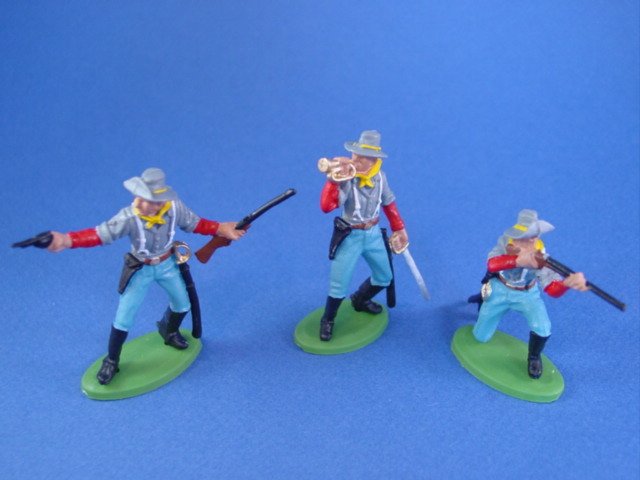
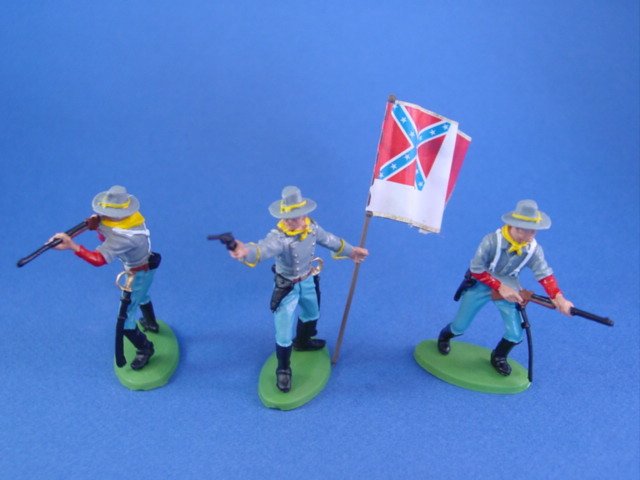
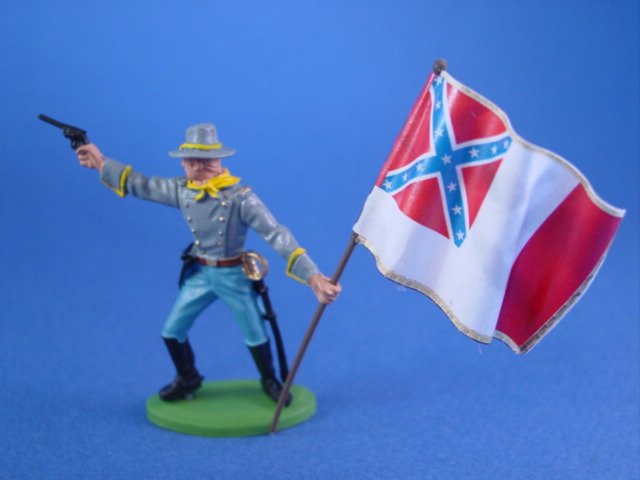 These are really weak sets and figures that come from DSG Argentina, its just 7th cavalry painted grey but if a little bit of imagination was used then we have a perfect opportumnity to create the real cavalry of this army. The uniforms lend themselves to the Texas black hatted cavalry so a colour change of the hat is needed, the braces seem wrong though and if you made some head changes with Britains cowboys you'd get a decent feel here


Godfrey of Bouillon by Mokarex
GODEFROY DE BOUILLON

Of greatest importance to us is the fact that many of these Manichaean groups permitted homosexual intercourse. They not only tolerated homosexuality, but went so far as to advocate its superiority over heterosexuality, on the grounds that the latter enslaved humanity in a chain of procreation which bound us to the earth and hence to Evil. They thus held in varying degrees of esteem all the non-procreative sex that the Christian Church condemned: masturbation, male and female homosexuality, anal and oral sex between men and women, and group sex-play that wasn't designed to produce offspring. The Church's condemnation of members of these cults as homosexuals as well as heretics was not only inevitable, but to a large extent accurate. templar by soldiers
Nevertheless the condemnation still had more to do with church politics than with morality. Most of these heretical groups, the Albigensians, Paulicians, Patarenes, Bogomiles, Cathars, etc., were rather puritanical in non-sexual areas and appealed not only to the common people, but to wealthy burghers and the nobility. The Cathars (a term meaning "the pure") were openly supported in France by the counts of Toulouse, Foix and Bezier, and the king of Aragon, and the princes seized Church property on the "religious" authority of the Cathars. It is hardly surprising, then, that the Church branded these people as heretics, and used the homosexual charge as an effective weapon in its crusade against them. Any defeat of heresy meant the confiscation of more property for the Church.
When Manichaeism entered France by way of Bulgarian immigrants in the eleventh century, the word bougre, meaning "Bulgarian," became synonymous with both "heretic" and "sodomite" — and survives in the English language today as "bugger." Nor is it insignificant that the Inquisition's official term for heresy was "heretical pravity," having much the same meaning as "depravity" and "sexual depravity."
The Order was founded in 1118 by Hughes de Paynes and eight French knights, followers of Godefroy de Bouillon. Their religious function was to defend the Holy Sepulcher, and to safeguard pilgrims to it. But due to the constant intermingling of cultures in that area, they quickly became adherents to the great heresy; just as quickly took up the sexual practices tolerated in the East, including homosexuality; and at the same time acquired vast wealth and property as traders and bankers. By the beginning of the fourteenth century, the Order comprised 15,500 Knights, an appropriate number of squires and lay brethren, more than 150,000 gold florins and over 10,000 manors, plus a few fortresses and Temples in every major city in Europe (including London, on the site now occupied by The Temple on the Embankment).
In other words, the Knights Templars were almost as powerful as the Holy Roman Church. Recognizing a threat when he saw one, Pope Clement V persuaded King Philip le Bel in 1307 to issue an arrest order, accusing the Knights Templars of sodomy, heresy, general abominations and criminal acts. Philip himself was homosexual, but he stood to gain much wealth by outlawing the "heretics." On October 13 of that year, Jacques de Molay, Grand Master of the Order, was arrested along with 140 Knights. They were hideously tortured, and confessed to heresy, sodomy, cannibalism and a host of other crimes. More than a hundred of them were then burned to death, and 51 more were cremated in 1311.
 The Order was formally abolished by the Pope in 1312, and on March 18, 1314, Jacques de Molay and his friend Guy D'Auvergne were burned at the stake. Just before dying, Molay ordered his persecutors to join him within the year "at the tribunal of God". Both Pope Clement and King Philip accordingly died before the year was over. But before their deaths they had totally eradicated the Knights Templars.
There is a great scholarly controversy over whether or not the Knights Templars actually were homosexual. It is impossible here to sum up the evidence for either side of the argument. I can only note the tendency in much recent scholarship to conclude that they were not cannibals etc., but that they were indeed "heretics" as defined by the Church, and that they did indeed engage in homosexual sex. Their initiation ceremony is well documented and has the ring of truth in spite of being extracted by torture. It involved such things as stripping oneself naked, kissing the high priest or leader on the mouth, anus and penis as a sign of fealty, and engaging in homosexual group sex as a symbol of brotherhood. Like the other heresies, they were theologically opposed to marriage and procreation, and taught that erotic tensions were better relieved with one's brothers than with women.
 dsg
dsg
It is against this political background in which heresy and homosexuality were so closely aligned as to be virtually identical, that the great Church Father St Thomas Aquinas (1225-74) formulated his Christian sexual ethics: "right reason declares the appointed end of sexual acts is procreation," and declared that homosexuality was one of the gravest of the peccata contra naturam or "sins against nature," which is still the official view of most Roman Catholic, Orthodox, and even Protestant Christian Churches.
 (Some commentators believe that the term "faggot" as applied to homosexuals is derived from the bundles of sticks or "faggots" that were used to burn the heretics. The heretics were easily identified with the fuel used to burn them, for symbolic faggots were in fact embroidered on the garments of those who refused to recant: hence the phrase "to fry a faggot." However, this etymology is probably not correct, because "faggot" as a slang term for a homosexual only occurs in English, and in England homosexuals were never burned at the stake, but hanged, so it is difficult to see how the metaphorical meaning could have arisen. The term is more likely derived from the French and Italian term baggage meaning "slut, whore.")
For nearly a century "heretical pravity" included only the cults of the Manichaean heresy, but in 1320 Pope John XXII gave his permission to the Inquisitors of Carcassone and Toulouse to prosecute witches. Whereas the Manichaean heresy was an Eastern religious import, witchcraft was native to Western Europe and the survival of a pagan cult. The heretics often came from the upper middle classes in urban centers, while the witches often came from the lower classes in rural areas relatively untouched by new-fangled religions, either Christian or heretical. Nevertheless the very widespread witch cult was a stumbling block to the enlargement of Christendom, and had to be similarly destroyed once the more powerful heresy groups had been disposed of. The Margaret Murray school of anthropological study argues that the witchcraft persecutions were primarily the result of a class war, or a new Christian culture stamping out a witchcraft culture. Many scholars believe that "witchcraft" may have existed as a kind of folk or pagan religion, and is not entirely a figment of a hysterical Christian imagination.
 by dsg
Homosexuality was often an important feature of the witches' real or alleged initiation rituals and the communion we now mistakenly refer to as the Black Mass. We have some well-documented evidence, freely given instead of extracted by torture, concerning the practice of one rite sometimes called the osculum infame, the "shameful" act of kissing the arse of the "Devil" or leader of the coven. It is first recorded in 1303 regarding the Bishop of Coventry, and is especially found in the records of the sixteenth century, for example: "le besa de derrier" (1563); "chacun de l'assemblee luy va baiser le derrier" (1567); "puis un chacun luy baisoit le derrier" (1574); "the deuel . . . caused all the company to com and kis his ers" (1590); "They kiss'd his Backside" (1594); "he wold hold up his taill untill we wold kiss his arce" (1662); "Satan offers his back-parts to be kissed of his vassal" (1617); and sometimes his genitals as well as his back parts: "que le Diable lui faisoit baiser son visage, puis le nombril, puis le membre viril, puis son derrier" (1609). Today the contemptuous phrase "kiss my arse" indicates a kind of humiliation, but in the heretical rites it was an act of humility and fealty, in much the same way that in an earlier era ritual prostitution was an act of humility and subservience to Cybele. This "kiss of shame" is still found in primitive initiation rituals today, and even in college fagging.

Responding to reports that Christian pilgrims to the Holy Land were abused by the Moslem authorities, Pope Urban II in 1095 A.D issued an appeal for European Christians to recapture Jerusalem. A large army led by Godfrey of Bouillon was assembled in Constantinople to carry out the Papal mission. “Deus volt” - God wills it! - was the battle cry. In 1099, the crusaders captured the Holy City after a battle in which 70,000 civilians were massacred. A French king was seated upon the throne of Jerusalem.
Throughout its early development, the Christian Church was under constant threat by the religious teachings of Mani, born in Persia in AD 216. His system, now called Manichaeism, held that evil was as powerful as goodness, contrary to the Christian view that the God of goodness was all-powerful, and it acquired an immense number of believers, no doubt because common sense tells us that evil is indeed a power to be reckoned with in the real world. During the early Middle Ages cults of this religion spread throughout Egypt, Asia Minor, Byzantium, northern Italy, southern France, the Balkans and Bulgaria. 
Godfrey of Bouillon was put as the head of the Latin Kingdom of Jerusalem some say that he was the most valiant and devoted of the crusader knights of the Knights Templar order. Godfrey of Bouillon refused the title and vestments of royalty, declaring that he would never wear a crown of gold in the city where his Lord and Master had worn a crown of thorns. The only title Godfrey of Bouillon would accept was that of "Defender of the Holy Sepulchre." Many of the crusaders, considering their vows fulfilled, now set out on their return to their homes, some making their way back by sea and some by land. Godfrey of Bouillon, Tancred, and a few hundred other knights, were all that stayed behind to maintain the conquests that had been made, and to act as guardians of the holy places and the Kingdom of Jerusalem.
Many of the early Christianb massacres were of Manichaean believers but this belief started to enter the Christian Church by its back door and also that of the Templars.Of greatest importance to us is the fact that many of these Manichaean groups permitted homosexual intercourse. They not only tolerated homosexuality, but went so far as to advocate its superiority over heterosexuality, on the grounds that the latter enslaved humanity in a chain of procreation which bound us to the earth and hence to Evil. They thus held in varying degrees of esteem all the non-procreative sex that the Christian Church condemned: masturbation, male and female homosexuality, anal and oral sex between men and women, and group sex-play that wasn't designed to produce offspring. The Church's condemnation of members of these cults as homosexuals as well as heretics was not only inevitable, but to a large extent accurate.
templar by soldiersNevertheless the condemnation still had more to do with church politics than with morality. Most of these heretical groups, the Albigensians, Paulicians, Patarenes, Bogomiles, Cathars, etc., were rather puritanical in non-sexual areas and appealed not only to the common people, but to wealthy burghers and the nobility. The Cathars (a term meaning "the pure") were openly supported in France by the counts of Toulouse, Foix and Bezier, and the king of Aragon, and the princes seized Church property on the "religious" authority of the Cathars. It is hardly surprising, then, that the Church branded these people as heretics, and used the homosexual charge as an effective weapon in its crusade against them. Any defeat of heresy meant the confiscation of more property for the Church.
When Manichaeism entered France by way of Bulgarian immigrants in the eleventh century, the word bougre, meaning "Bulgarian," became synonymous with both "heretic" and "sodomite" — and survives in the English language today as "bugger." Nor is it insignificant that the Inquisition's official term for heresy was "heretical pravity," having much the same meaning as "depravity" and "sexual depravity."
The Knights Templars
The Order was founded in 1118 by Hughes de Paynes and eight French knights, followers of Godefroy de Bouillon. Their religious function was to defend the Holy Sepulcher, and to safeguard pilgrims to it. But due to the constant intermingling of cultures in that area, they quickly became adherents to the great heresy; just as quickly took up the sexual practices tolerated in the East, including homosexuality; and at the same time acquired vast wealth and property as traders and bankers. By the beginning of the fourteenth century, the Order comprised 15,500 Knights, an appropriate number of squires and lay brethren, more than 150,000 gold florins and over 10,000 manors, plus a few fortresses and Temples in every major city in Europe (including London, on the site now occupied by The Temple on the Embankment).
In other words, the Knights Templars were almost as powerful as the Holy Roman Church. Recognizing a threat when he saw one, Pope Clement V persuaded King Philip le Bel in 1307 to issue an arrest order, accusing the Knights Templars of sodomy, heresy, general abominations and criminal acts. Philip himself was homosexual, but he stood to gain much wealth by outlawing the "heretics." On October 13 of that year, Jacques de Molay, Grand Master of the Order, was arrested along with 140 Knights. They were hideously tortured, and confessed to heresy, sodomy, cannibalism and a host of other crimes. More than a hundred of them were then burned to death, and 51 more were cremated in 1311.
The Order was formally abolished by the Pope in 1312, and on March 18, 1314, Jacques de Molay and his friend Guy D'Auvergne were burned at the stake. Just before dying, Molay ordered his persecutors to join him within the year "at the tribunal of God". Both Pope Clement and King Philip accordingly died before the year was over. But before their deaths they had totally eradicated the Knights Templars. There is a great scholarly controversy over whether or not the Knights Templars actually were homosexual. It is impossible here to sum up the evidence for either side of the argument. I can only note the tendency in much recent scholarship to conclude that they were not cannibals etc., but that they were indeed "heretics" as defined by the Church, and that they did indeed engage in homosexual sex. Their initiation ceremony is well documented and has the ring of truth in spite of being extracted by torture. It involved such things as stripping oneself naked, kissing the high priest or leader on the mouth, anus and penis as a sign of fealty, and engaging in homosexual group sex as a symbol of brotherhood. Like the other heresies, they were theologically opposed to marriage and procreation, and taught that erotic tensions were better relieved with one's brothers than with women.
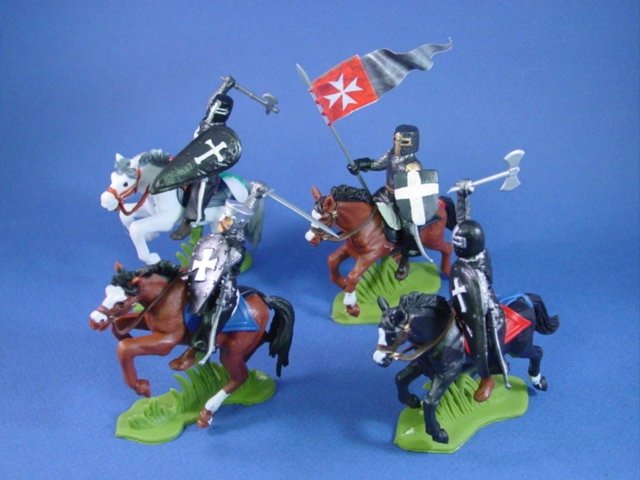
Fires and Faggots
 dsg
dsg It is against this political background in which heresy and homosexuality were so closely aligned as to be virtually identical, that the great Church Father St Thomas Aquinas (1225-74) formulated his Christian sexual ethics: "right reason declares the appointed end of sexual acts is procreation," and declared that homosexuality was one of the gravest of the peccata contra naturam or "sins against nature," which is still the official view of most Roman Catholic, Orthodox, and even Protestant Christian Churches.
(Some commentators believe that the term "faggot" as applied to homosexuals is derived from the bundles of sticks or "faggots" that were used to burn the heretics. The heretics were easily identified with the fuel used to burn them, for symbolic faggots were in fact embroidered on the garments of those who refused to recant: hence the phrase "to fry a faggot." However, this etymology is probably not correct, because "faggot" as a slang term for a homosexual only occurs in English, and in England homosexuals were never burned at the stake, but hanged, so it is difficult to see how the metaphorical meaning could have arisen. The term is more likely derived from the French and Italian term baggage meaning "slut, whore.") For nearly a century "heretical pravity" included only the cults of the Manichaean heresy, but in 1320 Pope John XXII gave his permission to the Inquisitors of Carcassone and Toulouse to prosecute witches. Whereas the Manichaean heresy was an Eastern religious import, witchcraft was native to Western Europe and the survival of a pagan cult. The heretics often came from the upper middle classes in urban centers, while the witches often came from the lower classes in rural areas relatively untouched by new-fangled religions, either Christian or heretical. Nevertheless the very widespread witch cult was a stumbling block to the enlargement of Christendom, and had to be similarly destroyed once the more powerful heresy groups had been disposed of. The Margaret Murray school of anthropological study argues that the witchcraft persecutions were primarily the result of a class war, or a new Christian culture stamping out a witchcraft culture. Many scholars believe that "witchcraft" may have existed as a kind of folk or pagan religion, and is not entirely a figment of a hysterical Christian imagination.
The Kiss of Shame
by dsg Homosexuality was often an important feature of the witches' real or alleged initiation rituals and the communion we now mistakenly refer to as the Black Mass. We have some well-documented evidence, freely given instead of extracted by torture, concerning the practice of one rite sometimes called the osculum infame, the "shameful" act of kissing the arse of the "Devil" or leader of the coven. It is first recorded in 1303 regarding the Bishop of Coventry, and is especially found in the records of the sixteenth century, for example: "le besa de derrier" (1563); "chacun de l'assemblee luy va baiser le derrier" (1567); "puis un chacun luy baisoit le derrier" (1574); "the deuel . . . caused all the company to com and kis his ers" (1590); "They kiss'd his Backside" (1594); "he wold hold up his taill untill we wold kiss his arce" (1662); "Satan offers his back-parts to be kissed of his vassal" (1617); and sometimes his genitals as well as his back parts: "que le Diable lui faisoit baiser son visage, puis le nombril, puis le membre viril, puis son derrier" (1609). Today the contemptuous phrase "kiss my arse" indicates a kind of humiliation, but in the heretical rites it was an act of humility and fealty, in much the same way that in an earlier era ritual prostitution was an act of humility and subservience to Cybele. This "kiss of shame" is still found in primitive initiation rituals today, and even in college fagging.
Tuesday, 3 May 2011
bataan and the lows to which human beings can sink

The lows that the Jap soldier could sink to are not reserved for an age where you may think "yes it was a part of the times" for one may ponder on the open air concentration or prison camp that is Palestine and where no one in the last fifty years seems to give a damn.
But the Japs hit levels of depravity only matched by the nazi and Italian concentration camp guards, the Japs were worse as their deprivation was directed to soldiers who had bravely fought them.
It is a myth to say that the Japs didnt understand surrender for they surrended in their droves when their campaign to enter India fell apart in Burma.The reason for the Jap deprivation is that it is a country lacking in public dissent I presume.
The battle for Bataan and its aftermath was a particularly brutal and horrifying event. Our forces were not prepared for the rapid succession of events in 1941 or for the abominable conditions they were to endure as the war unfolded.
Forced to fight with outdated weapons and ammunition, undernourished and fainting from hunger, and dealing with all the indigenous tropical diseases, many perished.
Believing that their four and one half months of torment was coming to an end at the time of surrender, they were to discover a higher level of suffering. Some soldiers could not believe that they had survived up to that point.
Many of their friends and fellow combatants had perished for no other reason than having been in the wrong place at the wrong time.
The Death March was to teach them the depravity to which the Japanese soldier could plumment. Many Filipinos and Americans suffered for lack of nourishment, water, disease and the new component, unchecked cruelty and barbarism. Again some lived and some died.
There was no rhyme or reason. The somewhat fit soldiers died from abuse as well as the sick and injured who could not endure the hardship.
There was no rhyme or reason. The somewhat fit soldiers died from abuse as well as the sick and injured who could not endure the hardship.
The next blows in close succession were the railroad ride from Capas to San Fernando where many died of suffocation and dehydration.
Afterwards was the ordeal at Camp O'Donnell. The conditions at O'Donnell are well known. Many thousands died from no other reason than a total lack of decency, compassion, humanity, kindness or whatever you wish to name it. Yet again many survived.
Afterwards was the ordeal at Camp O'Donnell. The conditions at O'Donnell are well known. Many thousands died from no other reason than a total lack of decency, compassion, humanity, kindness or whatever you wish to name it. Yet again many survived.
Cabanatuan was somewhat better, yet many perished there in the next few months for the same reasons stated above.
Then the insanity of the Hellships began to manifest itself. To have survived up to this point was a testament to courage and willpower, yet this was something almost unendurable. To be caged inside a somewhat furnace like situation, sitting in animal filth and forced to wallow in your own filth with limited water and food, was a new low even for the Japanese.
Many survived these trips of a month or more, however, again some perished. Those who suffered the conditions in these Hellships and eventually made to slave labor camps could consider themselves fortunate.
I say this because they had the fortune to be given a number by a nameless Japanese official which put them on a hellship that was not doomed to be attacked by air and by submarine of U. S. forces. Thousands of men who had the preserverence to survive the battle for Bataan, the Death March, the train to San Fernando, Camp O'Donnell, and Cabanatuan were killed by their own countrymen. They were slaughtered unknowingly because they had the misfortune of being shipped in unmarked Japanese freighters.
Then the insanity of the Hellships began to manifest itself. To have survived up to this point was a testament to courage and willpower, yet this was something almost unendurable. To be caged inside a somewhat furnace like situation, sitting in animal filth and forced to wallow in your own filth with limited water and food, was a new low even for the Japanese.
Many survived these trips of a month or more, however, again some perished. Those who suffered the conditions in these Hellships and eventually made to slave labor camps could consider themselves fortunate.
I say this because they had the fortune to be given a number by a nameless Japanese official which put them on a hellship that was not doomed to be attacked by air and by submarine of U. S. forces. Thousands of men who had the preserverence to survive the battle for Bataan, the Death March, the train to San Fernando, Camp O'Donnell, and Cabanatuan were killed by their own countrymen. They were slaughtered unknowingly because they had the misfortune of being shipped in unmarked Japanese freighters.
The final insult was to become a slave laborer on the Japanese mainland or elsewhere. Forced to work long hours in dangerous mines and factories, many more died. Some from accidents and some disease and malnutrition and of course the ever present mistreatment by their tormentors.

Monday, 2 May 2011
Bill cody by Atlantic in 1/32


Subscribe to:
Posts (Atom)