
Friday, 23 November 2012


Tuesday, 20 November 2012
the legion , the early years
 France's experience in Africa was conditioned by two things. First, France had a longstanding interest in the region bordering the Mediterranean Sea thanks to its own coast line between Italy and Spain, its active role in the
 Crusades and its incorporation into the Roman Empire. Second, France lost most of its original overseas empire in the Seven Years War (1756-1763) and the Napoleonic Wars (1790s-1815) and it suffered a
 major setback in its defeat in the Franco-Prussian War (1870-1871). Thus, French imperialism was an effort to regain lost power rather than a continuation of previous successes, and its African empire grew out of developments along the North African coast.

The French first occupied African soil in Algeria in 1830 while trying to reestablish their authority in the Mediterranean.
 Since 1684, when Louis XIV ordered the bombardment of Algiers in an effort to retrieve Christian slaves, to the reprisals launched after the Napoleonic Wars against cities along the "Barbary Coast" that supported pirates,
 the French viewed North Africa as a source of opposition. After peace was restored in 1815, the piracy stopped but relations remained very tense.

In 1828 Hussein, the Dey of Algiers, struck French consul Pierre Deval with his fly whisk. Deval reported it back to his king as an insult and two years later, Charles X used it as a pretext to invade Algiers. The invasion began on 5 July 1830 and the French quickly occupied the city. That ignited resistance in the Algerian interior and during two wars that were fought between 1832 and 1837, rural Berbers united behind Abd al-Qadir (alternate spelling: Abd el-Kader) to oppose the French.
After a third war against al-Qadir's forces failed to defeat him in 1840-1841, the French began to use terror tactics that included the destruction of wells and crops. On two occasions, French military forces pursued al-Qadir into land claimed by Morocco--an independent country--and finally captured him in 1847.

To quiet Moroccan protests, France signed the Treaty of Tangier on September 10, 1844 which provided French recognition of Moroccan independence and promises not to invade Morocco again.

Berber uprisings continued in central Algeria until 1873 when the French occupied the strategically-located oasis of El Golea, 540 miles south of Algiers. Resistance continued deeper in the desert and in 1880-1881, the nomadic Tuaregs wiped out an expedition led by the French Colonel Paul Flatters as it tried to survey a railroad route acress the Sahara Desert. Resistance continued in the desert until 1932 when the use of airplanes, radios and trucks made it possible to locate and pursue nomads. [NOTE: Resistance by desert dwellers against outsiders flared up occasionally after that, and led to guerilla warfare against the independent governments of Algeria, Mali, Mauritania and Niger as recently as 2003.]
The first French initiative south of the Sahara took place along the Senegalese coast in 1843 under the leadership of Governor General Bouet Willaumez. He initiated a period of expansion by capturing the port of St. Louis at the mouth of the Senegal River and allowing privately-owned trading companies (mostly from Bordeaux) to handle the administration of the town. That ended in 1848 when the new French government of the Second Republic took over the local administration.

Imperial France gradually absorbed the territories of present-day Mauritania from the Senegal river area and upwards, starting in the late 19th century. In 1901, Xavier Coppolani took charge of the imperial
 mission. Through a combination
 of strategic alliances with Zawiya tribes, and military pressure on the Hassane warrior nomads, he
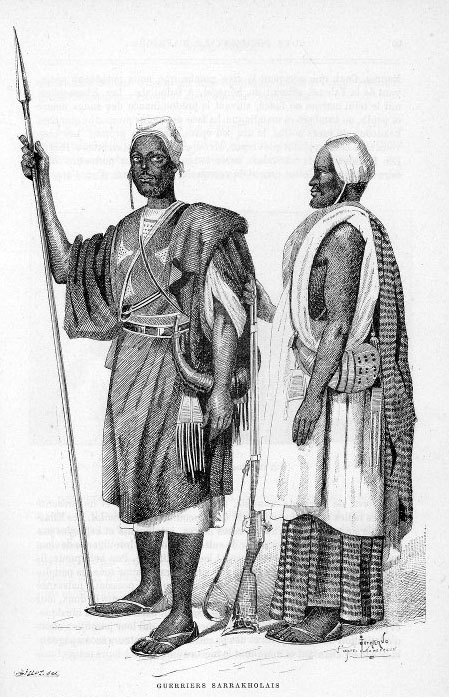
 managed to extend French rule over the Mauritanian emirates: Trarza, Brakna and Tagant quickly submitted to treaties with the colonial power. these are hat zouves but the trousers are more that of early french foreign legion, just change the headgear to a kepi.
 (1903–04), but the northern emirate of Adrar held out longer, aided by the anticolonial rebellion (or
 jihad) of shaykh Maa al-Aynayn. It was finally defeated militarily in 1912, and incorporated into the territory of Mauritania, which had been drawn up in 1904. Mauritania would subsequently form part of French West Africa, from 1920.
French rule brought legal prohibitions against slavery, and an end to interclan warfare. During the colonial period, the population remained nomadic, but many sedentary peoples, whose ancestors had been expelled centuries earlier, began to trickle back into Mauritania. As the country gained independence in 1960, the capital city Nouakchott was founded at the site of a small colonial village, the Ksar, while 90% of the population was still nomadic.

The great Sahel droughts of the early 1970s caused massive problems in Mauritania. With independence, larger numbers of indigenous Sub-Saharan African peoples (Haalpulaar,
 Soninke, and Wolof) entered
 From 1854 to 1863, he directed a series of expeditions that established a line of French forts along the lower Senegal River as far east as Médine. During the same period, the French government took complete control over the local administration of the port city of St. Louis from the Bordeaux merchant firms.
 TtHE ABOVE IS MY OWN CRESCENT CONVERSION OF THEIR 54MM FIGURE


SOUDAN

Consequently, the French exhausted an enormous amount of effort to claim it even though its economic value was small.
Prior to the 1850s, there was no French presence in the Soudan, although French explorer René Caillié passed through the area enroute to becoming the first European to return from Timbuktu in 1827-1828. In 1855 Faidherbe's troops began their advance towards the Upper Senegal River and built a fort at Médine, just below the Félou waterfall. Beyond that lay the empire of Ahmadu Tall with its capital at Ségou on the Niger River, and the empire of Samory Touré to the south east, with a capital at Sanankoro on the south side of the Niger River.
For a time, the French felt no need to formalize their presence, but as the British began to move inland from the mouth of the Niger River, the French began to fear that the British would seize the Middle Niger Valley and perhaps even reach the Upper Senegal Valley. That fear inspired a new episode of French aggression from 1876-1881 when Governor Brière de l'Isle authorized the construction of a railroad to the Niger and the creation of a military government of Haut Senegal et Niger (literally "Upper Senegal and Niger"), an area encompassing the modern states of Mali and Niger. [For more on this episode, see
The African empires offered resistance, so it took a decade for the French to conquer Ségou and almost twenty more years to defeat Samory. Resistance continued in the region around Lake Chad until 1900 and in the Sahara Desert until the 1930s. But by 1899, the French were able to place the Soudan under its own administration. IVORY COAST |  Samory Touré, leader of the last major anti-French resistance in the western Sudan Source: Gallieni, Deux campagnes ... |
 in 1894, they received help from newspaper correspondents who wrote unconfirmable accounts of African cruelty and barbaric acts. Since the only Europeans in a position to verify such reports were soldiers, the public never heard anyone defend African culture.

Dahomey was located between British Nigeria and German Togo along what Europeans called the "Slave Coast." French merchants began to trade there in the 17th century and in 1851, traders from Marseille signed a treaty of protection with King Guezo of Abomey which gave the French the right to build a permanent base on the coast at Ouidah. Another French trader named Daumas signed a similar treaty with King Sodji of Porto-Novo in 1863. Sodji's successor (Mekpu) tried to renounce the treaty with the French, but after he was defeated by a rival with French assistance in 1883, the French government became confident enough to make Porto Novo the capital of their possessions in the Gulf of Benin.
This was an affront to the kings of Abomey, who considered Porto Novo to be part of their realm. King Glegle of Abomey revoked his father's treaty in 1884 and the French sent a military expedition to restore their control. Glegle's death in 1889 placed his son Behanzin on the throne, and when Behanzin appeared likely to continue his father's opposition, the French responded by occupying Cotonou, a coastal village near the Abomey capital.
French newspapers helped drum up support for this effort with descriptions of human sacrifices that accompanied Behanzin's coronation. They also lavished attention on the troops who fought for the French including Foreign Legionnaires from Algeria and Tirailleurs (African troops in the French colonial army) from Senegal. The use of new technology such as the telegraph, repeating rifles, steam gunboats and machine guns also attracted interest, while reports of Dahomeyan "Amazons"-- military units composed entirely of women--titillated the French public's imagination.
The climax came in 1892 when an expedition led by a Senegalese mulatto, Colonel Alfred Amédée Dodds, marched from Ouidah to Abomey with four thousand soldiers. Following a series of battles in September and October, including several that pitted Legionnaires against Abomey's Amazons. the French reached the capital on November 17. King Behanzin had already fled, so the French amused themselves by collecting souvenirs including a white parasol decorated with human jawbones that received a great deal of attention from the press. Behanzin remained on the run until January 1894 when he was captured and exiled to Martinique. The French finished the campaign with 81 dead, 436 wounded and about 2,000 other casualties due to illness.
The 1892 French campaign in Dahomey affected European attitudes about Africa. It seemed to confirm that even a prosperous and well-organized state like Dahomey depended on practices--human sacrifice, women soldiers--that scandalized Victorian Europe. When the British launched the
Supporters of French expansion proposed both practical and idealistic goals. Practically speaking, French imperialists hoped to enhance the French economy to help pay the Prussian indemnity and to recover from the Great Depression of the 1870s. They also wanted to block British expansion in West Africa. On a more idealistic level, French imperialists envisioned the creation of a Greater French Empire that would promote what they considered to be the universal ideals of the Enlightenment. Coincidentally, such an empire was expected to extend and glorify French culture.
Philosophy professor Albert Memmi wrote in The Colonist and the Colonized (Boston, MA: Beacon Press, 1967) that the French had to have a grandiose concept of their own culture in order for expansion to succeed because the colonial system attracted only the most mediocre Europeans. Memmi argued that the colonizers were aware of their own mediocrity, so they bolstered their position with respect to colonized Africans by extolling the virtues of the French civilization. Coincidently, they viewed themselves as the best representatives of that civilization.
Writing about French politics in Jules Ferry and the Renaissance of French Imperialism, (London: King's Crown Press, 1944)., Thomas Power agreed with Memmi that the economic motive was secondary and argued that France's principle motivations were strategic and ideological. Power wrote that the economic arguments advanced by Jules Ferry to justify expansion, were created after the fact as a way to obtain financial support from the French legislature for projects that were already underway. [Power, 1944, 198.]
Once treaties were signed and French administration put in place, the French tried to convert Africans into citizens who understood the ideals of French civilization. To create citizens from uneducated Africans, the French employed a policy of assimilation which relied on white Frenchmen as teachers and models for African pupils whose object was to mimic French culture.
Not only did this serve the French government's need to demonstrate high moral purpose by "raising up the heathen," it also offered cost advantages. Africans who wanted to become French were not likely to revolt, so the French could do without expensive military garrisons to maintain order. Assimilated Africans also served in the lower levels of administration, saving the cost of bringing Europeans to Africa to fill their positions.
Viewed as an episode in French history, the conquest of Africa was a continuation of expansion of power that began under Louis XIII. In roughly three centuries, French governments extended their control from the Ile de France (surrounding Paris) to the North African coast. The conquest of West Africa was just the next step in this long process. From the perspective of other Europeans, France's expansion was seen as a form of opposition to Great Britain. The British felt threatened by it, the German prime miniser Bismarck encouraged it and the rest of the European nations tried to imitate it.

Friday, 16 November 2012
el durado

The lust for gold spans all eras, races, and
nationalities. To possess any amount of gold seems to ignite an
insatiable desire to obtain more.
Through the centuries, this passion gave rise to the enduring tale of a city of gold. In the 16th and 17th centuries, Europeans believed that somewhere in the New World there was a place of immense wealth known as El Dorado. Their searches for this treasure wasted countless lives, drove at least one man to suicide, and put another man under the executioner's ax.
"El Dorado shifted geographical locations until finally it simply meant a source of untold riches somewhere in the Americas," says Jim Griffith, a folklorist in Tucson, Arizona.
But this place of immeasurable riches hasn't been found.
The origins of El Dorado lie deep in South America. And like all enduring legends, the tale of El Dorado contains some scraps of truth. When Spanish explorers reached South America in the early 16th century, they heard stories about a tribe of natives high in the Andes mountains in what is now Colombia. When a new chieftain rose to power, his rule began with a ceremony at Lake Guatavita. Accounts of the ceremony vary, but they consistently say the new ruler was covered with gold dust, and that gold and precious jewels were thrown into the lake to appease a god that lived underwater.
The Spaniards started calling this golden chief El Dorado, "the gilded one." The ceremony of the gilded man supposedly ended in the late 15th century when El Dorado and his subjects were conquered by another tribe. But the Spaniards and other Europeans had found so much gold among the natives along the continent's northern coast that they believed there had to be a place of great wealth somewhere in the interior. The Spaniards didn't find El Dorado, but they did find Lake Guatavita and tried to drain it in 1545. They lowered its level enough to find hundreds of pieces of gold along the lake's edge. But the presumed fabulous treasure in the deeper water was beyond their reach.
Raleigh's Quest
English courtier Sir Walter Raleigh made two trips to Guiana to search for El Dorado. During his second trip in 1617, he sent his son, Watt Raleigh, with an expedition up the Orinoco River. But Walter Raleigh, then an old man, stayed behind at a base camp on the island of Trinidad. The expedition was a disaster, and Watt Raleigh was killed in a battle with Spaniards. Eric Klingelhofer, an archaeologist at Mercer University in Macon, Georgia, says Walter Raleigh was furious at the survivor who informed him of Watt's death and accused the survivor of letting his son be killed. "The man goes into his cabin on the ship and kills himself," says Klingelhofer, who is trying to find the site of Raleigh's base camp on Trinidad.
Raleigh returned to England, where King James ordered him beheaded for, among other things, disobeying orders to avoid conflict with the Spanish.
The legend of El Dorado endures because "you want it to be true," says Jose Oliver, a lecturer at the Institute of Archaeology at University College London. "I don't think we've ever stopped seeking El Dorado."
So where is this lost city of gold? In his 1849 poem "El Dorado," writer Edgar Allan Poe offers an eerie and eloquent suggestion: "Over the Mountains of the Moon, down the Valley of the Shadow, ride, boldly ride…if you seek for El Dorado."
Wednesday, 14 November 2012


Sunday, 4 November 2012

Friday, 2 November 2012

from bolt action
 This boxed set is based on a ruined farmhouse is extremely versatile in
that it can be built in several ways and is also ideal for use in many
periods – from Napoleonics to WWII.
Monday, 29 October 2012

Sunday, 21 October 2012
Brunswick Jägers

The Brunswick-Oels Jägers landed in Lisbon on October 1810. The Regiment comprised 12 companies and a regimental headquarters. Three companies were sharpshooters companies, armed with the Baker rifle. These companies were detached to serve with the British 4th and 5th division, one company served with the 3rd battalion of the 1st Regiment of foot (Royal Scots)., the others were with the Crauford´s Light division.

They served in the peninsula many battles and actions as crack skirmishers, like the famous 95th Rifles and the KGL Sharpshooters.
The uniform was slightly different from the other companies of the Brunswick-Oels.

 (1771–1815) to fight in the Napoleonic Wars. The Duke was a harsh opponent of Napoleon Bonaparte's occupation of his native Germany. Formed in 1809 when war broke out between the First French Empire and the Austrian Empire, the corps initially comprised a mixed force, around 2,300 strong, of infantry, cavalry and later supporting artillery
Distinctively attired in black broadcloth with a silvered death's head badge on their hats, the volunteers were nicknamed the Black Horde or the Black Legion; their more commonly-known title was the result of the Duke's temporary capture of the German city of Braunschweig (Brunswick) from the French in 1809. The Black Brunswickers earned themselves a fearsome reputation over the following decade, taking part in several significant battles including the pre-Waterloo engagement at Quatre Bras on 16 June 1815, where the Duke lost his life. However, recruiting, the replacement of casualties, and finance had always been problematic, and the corps was disbanded in the early 1820s.
The exploits of the Brunswickers caught the British Victorian public imagination: an example of this can be found in John Everett Millais's painting The Black Brunswicker.
 Completed in 1860, the painting depicts a Brunswicker in his black uniform bidding goodbye to an unnamed woman.
Tuesday, 16 October 2012

Friday, 12 October 2012

Tuesday, 9 October 2012
victor takes all


.Following the Operation Dragoon landings in southern France and the collapse of the German military occupation in August 1944, large numbers of Germans could not escape from France and surrendered to the French Forces of the Interior. The Resistance executed a few of the Wehrmacht and most of the Gestapo or SS prisoners.
Operation Dragoon was the Allied invasion of southern France on August 15, 1944, during World War II. The invasion was initiated via a parachute drop by the 1st Airborne Task Force, followed by an amphibious assault by elements of the U.S. Seventh Army, followed a day later by a force made up primarily of the French First Army. The landing caused the German Army Group G to abandon southern France and to retreat under constant Allied attacks to the Vosges Mountains. Despite being a large and complex military operation with a well-executed amphibious and airborne component, Operation Dragoon is not well known; it came in the later stages of the war and was overshadowed by the earlier and larger Operation Overlord During planning stages, the operation was known as "Anvil", to complement Operation Sledgehammer, at that time the code name for theinvasion of Normandy. Subsequently, both plans were renamed, Sledgehammer becoming Operation Overlord, and Anvil becoming Operation Dragoon. An apocryphal story holds that the name was chosen by the British prime minister, Winston Churchill, who was opposed to the plan and claimed to having been "dragooned" into accepting it
Other accounts attest that the operation was named afte rDraguignan, a city near the invasion site.
Despite being a large and complex military operation with a well-executed amphibious and airborne component, Operation Dragoon is not well known; it came in the later stages of the war and was overshadowed by the earlier and larger Operation Overlord During planning stages, the operation was known as "Anvil", to complement Operation Sledgehammer, at that time the code name for theinvasion of Normandy. Subsequently, both plans were renamed, Sledgehammer becoming Operation Overlord, and Anvil becoming Operation Dragoon. An apocryphal story holds that the name was chosen by the British prime minister, Winston Churchill, who was opposed to the plan and claimed to having been "dragooned" into accepting itOther accounts attest that the operation was named afte
rDraguignan, a city near the invasion site. 
Operation Dragoon was controversial from the time it was first proposed. The American military leadership and their British counterparts disagreed on the operation. Churchill argued against it on the grounds that it diverted military resources that were better deployed in the on-going Allied operations in Italy; instead, he favoured an invasion of the oil-producing regions of the Balkans. Churchill reasoned that by attacking the Balkans, the western Allies could deny Germany oil, forestall the advance of the Red Army of the Soviet Union, and achieve a superior negotiating position in post-war Europe, all at a single stroke. At the time Operation Anvil was first considered, the Allied landing at Anzio had gone badly and planning was put on ice.
The operation, now renamed Dragoon, was revived after the successful execution of the Normandy landings, which freed vital amphibious assets. In addition, the Allies were struggling to resupply their growing forces in France, because the Germans had destroyed the port facilities at Cherbourg and a storm had damaged the artificial harbour at Omaha Beach. This made seizure and control of the French ports at Marseilles and Toulon increasingly attractive. The French leaders pressed for an invasion in southern France too. Finally on 14 July 1944 the operation was authorized by the Allied Combined Chiefs of StaffThe U.S. 6th Army Group, also known as the Southern Group and as Dragoon Force, commanded by Lieutenant General Jacob L. Devers,
 was created to carry out the Operation. It was formed in Corsica and activated on 1 August 1944 to consolidate the French and American forces slated to invade southern France. As addition, Task Force 88 was also activated in August to support the landing. It was planned that the forces of the US Seventh Army, commanded by Alexander Patch, would make the initial landing, to be followed by the French Army B commanded by Jean de Lattre de Tassigny
 .Accompanying the whole operation was a fully mobilized unit called "Taskforce Butler", consisting of the bulk of the Allied tanks, tank destroyers and mechanized infantry. In addition, the French Resistance of the FFI played a major role in fighting, tying down numerous German troops. French resistance fighters also supplied the Allies with vital intelligence information and sabotaged German operations.
and a storm had damaged the artificial harbour at Omaha Beach. This made seizure and control of the French ports at Marseilles and Toulon increasingly attractive. The French leaders pressed for an invasion in southern France too. Finally on 14 July 1944 the operation was authorized by the Allied Combined Chiefs of StaffThe U.S. 6th Army Group, also known as the Southern Group and as Dragoon Force, commanded by Lieutenant General Jacob L. Devers, was created to carry out the Operation. It was formed in Corsica and activated on 1 August 1944 to consolidate the French and American forces slated to invade southern France. As addition, Task Force 88 was also activated in August to support the landing. It was planned that the forces of the US Seventh Army, commanded by Alexander Patch, would make the initial landing, to be followed by the French Army B commanded by Jean de Lattre de Tassigny.Accompanying the whole operation was a fully mobilized unit called "Taskforce Butler", consisting of the bulk of the Allied tanks, tank destroyers and mechanized infantry. In addition, the French Resistance of the FFI played a major role in fighting, tying down numerous German troops. French resistance fighters also supplied the Allies with vital intelligence information and sabotaged German operations.
In conjunction with the amphibious landing, several airborne operations were planned, conducted by a combined US-British airborne unit, the 1st Airborne Task Force.


The German command chain was overly complex, with parallel chains for the occupation forces, the land forces, the Luftwaffe and the Kriegsmarine commands. As part of their defense, the Germans had several fortifications and coastal guns which they had constructed during the years of occupation The Luftwaffe as well as the Kriegsmarine played a negligible role in the operationOpposing the Allies was the German Army Group G
 (Heeresgruppe G). As southern France had never been important to German planning, their forces there had been stripped of nearly all their valuable units and equipment over the course of the war. The remaining 11 divisions were understrength and only one intact Panzer Division was left, the 11th Panzer Division,
 which also had lost two of its tank battalions. The troops were positioned thinly along the French coast, with an average of 90 km (56 mi) per division. Generally the troops of the German divisions were only second and third grade. This meant that over the course of the years, Germans in those divisions were sent away and replaced with wounded old veterans as well as Volksdeutsche
 from Poland and Czechoslovakia. There were numerousOstlegionen inserted, as well as several units made up from volunteered Soviet prisoners of war (Ostbataillone). The equipment of those troops was in poor shape, consisting of obsolete weapons from various nations, with French, Polish, Soviet, Italian and Czech guns, artillery and mortars. Four of the German divisions were designated as "static", which meant that they were stripped of all of their mobile capabilities and unable to move from their assigned position. The only potent unit inside Army Group G was the 11th Panzer Division
]Initially, the chief operational objective of Operation Dragoon was the capture of the important French ports of Marseilles and Toulon, which were considered as essential to supply the growing Allied forces in France. The Allied planners used lessons learned from the Anzio and Normandy landings. They chose a location without high ground controlled by the Wehrmacht, as such conditions had forced them to incur heavy casualties after the initial landings at Normandy. The Allies chose an area at the Var
 coast east of Toulon as the landing site. Prior to the invasion, an air campaign was planned to isolate the battlefield and cut the Germans off from reinforcement by destroying several key bridges. Also a large airborne landing was planned in the center of the landing zone to quickly seize the high ground overlooking the beaches. Parallel to the invasion, several commando units would seize the islands off the coast.
Although the German Command expected another Allied landing in the Mediterranean, the advancing Red Army and the Allied Landing at the Normandy required all German resources, so little was done to improve the condition of Army Group G. Given the advancing Allied forces in northern France, the German Command deemed a realistic defense in the South impossible. Blaskowitz'sArmy Group G headquarter openly discussed a general withdrawal from southern France in July and August with the German High Command, but the 20 July plot led to an atmosphere in which any withdrawal was out of question. Blaskowitz was quite aware that with his scattered forces any serious Allied landing attempt would be impossible to ward off. He planned the withdrawal in secret, to include demolition of the ports and conduct an ordered withdrawal, covered by the 11th Panzer Division. He intended to establish a new defense line centered on Dijon in central France. German intelligence was aware of the impending Allied landing, and on 13 August Blaskowitz ordered the 11th Panzer Division to move east of the Rhone River, where the landing was expected.The preceding bombing missions together with resistance sabotage acts hit the Germans badly, interrupting railways, damaging bridges, and disrupting the communication network. The landing started on the morning of 15 August.
The assault troops were formed of three American divisions of the VI Corps, reinforced by the French 1st Armoured Division, all under the command of Lieutenant General Lucian K. Truscott, Jr. . The 3rd Infantry Division landed on the left at Alpha Beach (Cavalaire-sur-Mer), the 45th Infantry Divisionlanded in the centre at Delta Beach (Saint-Tropez),
 and the 36th Infantry Division landed on the right at Camel Beach (Saint-Raphaël). The U.S. 93rd Evacuation Hospital landed at Sainte-Maxime
 six hours after the initial landings.The landings were overwhelmingly successful. On Delta and Alpha beaches, German resistance was low. The Osttruppen surrendered quickly, and the biggest threat to the Allies were the mines. A single German gun as well as a mortar position was silenced by destroyer fire. The Allied units in this sector were able to link up with the paratroopers very quickly and succeeded in capturing the nearby towns. Only on Camel Beach did the Germans put up some serious resistance. This beach was secured by several well emplaced coastal guns as well as several flak batteries. Here too, the Osttruppen surrendered quickly; the German artillery formed the main opposition and some bunkers provided heavy resistance.
. The 3rd Infantry Division landed on the left at Alpha Beach (Cavalaire-sur-Mer), the 45th Infantry Divisionlanded in the centre at Delta Beach (Saint-Tropez), and the 36th Infantry Division landed on the right at Camel Beach (Saint-Raphaël). The U.S. 93rd Evacuation Hospital landed at Sainte-Maxime six hours after the initial landings.The landings were overwhelmingly successful. On Delta and Alpha beaches, German resistance was low. The Osttruppen surrendered quickly, and the biggest threat to the Allies were the mines. A single German gun as well as a mortar position was silenced by destroyer fire. The Allied units in this sector were able to link up with the paratroopers very quickly and succeeded in capturing the nearby towns. Only on Camel Beach did the Germans put up some serious resistance. This beach was secured by several well emplaced coastal guns as well as several flak batteries. Here too, the Osttruppen surrendered quickly; the German artillery formed the main opposition and some bunkers provided heavy resistance.
The most serious fighting was on Camel Red Beach at the town of Saint-Raphaël. A bombing run of 90 Allied B-24 bombers were used against a German strongpoint here. But even with the assistance of naval fire, the Allies were not able to bring the landing ships close to the beach. They decided to avoid Camel Red and land only at Camel Blue and Camel Green, which was successful. The Allied casualties at the landings were very light, with only 95 killed and 385 wounded. 40 of those casualties were caused by a Henschel Hs 293 launched from a Do-217
 , which sank the USS LST-282.
launched from a Do-217, which sank the USS LST-282.
Parallel to the main landings, several special force missions were carried out. At Cap Nègre to the west of the main invasion, a large group of French commandoes destroyed German artillery emplacements (Operation Romeo). These commandoes were supported by other French commando teams that landed on both flanks. In one of those missions, 67 French commandoes were taken prisoner after they ran into a minefield. The airborne and glider landings (Mission Dove, Mission Albatross and Mission Bluebird) around the area of Le Muy accompanying the whole operation, were as successful as the beach landings, with only 434 dead, mostly due to the hazardous landing conditions and not to German resistance. To protect the beachhead, the 1st Special Service Force took two offshore islands (Operation Sitka). Operation Span, a deception plan, was also carried out to shield the main invasion.
The Germans were initially confused, because of the cutting of their communication lines by the French Resistance. Blaskowitz started to consolidate his units for the planned withdrawal. With almost no mobile reserves to react against the beach landings, he ordered the commander of the 189th Infantry Division, Richard von Schwerin, to establish an ad-hoc battle group (Kampfgruppe) of all nearby units to counterattack against Le Muy and the beaches. On the next morning, this battle group of now four infantry regiments attacked toward Le Muy from the town of Les Arcs, Var.

to establish an ad-hoc battle group (Kampfgruppe) of all nearby units to counterattack against Le Muy and the beaches. On the next morning, this battle group of now four infantry regiments attacked toward Le Muy from the town of Les Arcs, Var.
By that time the Allies had already landed thousands of troops, vehicles and hundreds of tanks. The Allied mobile forces went out against the German forces at Les Arcs and threatened to cut them off. After heavy fighting the whole day, von Schwerin ordered his troops to retreat in the cover of the night. At the same time heavy fighting occurred in Saint-Raphaël. A battalion of the 148th Infantry Division attempted to counterattack against the beaches, but was repulsed by the Allied forces. The Allies linked up with troops in Le Muy on 17 August
By the night of 16/17 August, Army Group G headquarters realized that they could not drive the Allies back into the sea. German movement was generally hindered by a Maquis uprising. In northern France, the Falaise pocket threatened the loss of major German forces. Given the precarious situation, Hitler moved away from his "no step backward" agenda and agreed to an OKW plan for the complete withdrawal of Army Group G and B. The OKW plan was for all German forces (except the stationary fortress-troops) in southern France to move north to link up with Army Group B to form a new defensive line from Sens through Dijon to the Swiss frontier. Two German divisions (148th and 158th) were to retreat into the French-Italian Alps. The Allies were privy to the German plan through Ultra interception.
The Germans started to withdraw, while the motorized Allied forces advanced very fast and threatened to cut off major German units. The US 3rd Division pursued the retreating German forces from behind. The Germans tried to establish a defense line at the Rhône to shield the withdrawal of several valuable units (e.g. the 11th Panzer Division). Digne was liberated on 18 August. The 157th Division retreated from Grenoble on 21 August toward the Alps, leaving a large gap in the eastern flank of the retreating Army Group G. Army Group G now decided to sacrifice 242nd Infantry Division in Toulon as well as the 244th Infantry Division in Marseille to buy time for the rest of Army Group G to retreat trough the Rhône Valley, while the 11th Panzer Division and the 198th Infantry Division would shield the retreat in several defense-lines.Meanwhile the landed French units started to head for the two ports. After heavy fighting around Hyères, they approached Toulon on 19 August. The ensuing battle lasted until 27 August, when the remaining German units surrendered. The battle for Toulon cost the French 2,700 casualties, but they captured 17,000 Germans. Several Allied warships were also hit by coastal artillery during the fighting At the same time, the liberation of Marseille commenced on 21 August. The German units were exhausted from partisan fighting against the FFI. The Wehrmacht was not able to defend on a broad front and soon crumbled into numerous isolated strongpoints. On 27 August most of the city was liberated, with only some small strongpoints remaining. The battle took 1,825 French casualties, but 11,000 German troops were captured. In both harbours, German engineers had demolished port facilities to deny the use of the ports to the Allies.
In the meantime the German retreat continued. The 11th Panzer Division started several feint attacks toward Aix-en-Provence to discourage any further Allied advance. The Allies recognized the open German flank at the east of the Rhone and decided to push with Taskforce Butler, as well as the 36th Division, into this open gap to cut off the German retreat at Montélimar. The Allies occupied the hills near the town and began firing on the retreating Germans. The shocked German command ordered the 11th Panzer Division to deal with this new threat. Meanwhile the Allies strengthened their positions around Montélimar, posing a threat for the whole German retreat. Several hastily assembled counterattacks failed, but on 24 August the 11th Panzer Division arrived and stopped the Allied advance, which suffered from a lack of supply and fuel caused by their rapid progress. On 25 August the Germans attempted a heavy assault on the American positions, which failed. The Allies were able to establish a temporary roadblock, but were thrown back by the 11th Panzer Division shortly after. Over the next days, a stalemate emerged, with the Allies unable to block the retreat route and the Germans unable to clear the area of the Allied forces. Finally from 26–28 August, the majority of the German forces was able to escape and on 29 August the Allies captured Montélimar. The Germans suffered 2,100 battle casualties plus 8,000 POWs, while the Americans had 1,575 casualties.

The Allies occupied the hills near the town and began firing on the retreating Germans. The shocked German command ordered the 11th Panzer Division to deal with this new threat. Meanwhile the Allies strengthened their positions around Montélimar, posing a threat for the whole German retreat. Several hastily assembled counterattacks failed, but on 24 August the 11th Panzer Division arrived and stopped the Allied advance, which suffered from a lack of supply and fuel caused by their rapid progress. On 25 August the Germans attempted a heavy assault on the American positions, which failed. The Allies were able to establish a temporary roadblock, but were thrown back by the 11th Panzer Division shortly after. Over the next days, a stalemate emerged, with the Allies unable to block the retreat route and the Germans unable to clear the area of the Allied forces. Finally from 26–28 August, the majority of the German forces was able to escape and on 29 August the Allies captured Montélimar. The Germans suffered 2,100 battle casualties plus 8,000 POWs, while the Americans had 1,575 casualties.
The US VI Corps together with units from the French II Corps pursued and tried to cut off the German forces on their way toward the town of Dijon, while the Germans planned to prevent another Montélimar with a defensive shielding by the 11th Panzer Division. The American 45th Division and the 11th Panzer Division raced north to fulfill their objectives, which led to several heavy engagements at Meximieux, in which the American units took heavy casualties, while the main German units retreated through Lyons. On 3 September Lyons was liberated, but the Germans had already escaped. The Allies made a last-ditch attempt to cut the Germans off by taking the towns of Montreval and Marboz north of Bourg, which was thwarted by the 11th Panzer Division in heavy fighting. For the next two weeks more skirmishes occurred and the Allies were not able to cut off a major body of the German forces, but the Germans were also not able to maintain any stable defense line as planned. On 10 September Dragoon units were able to establish contact with units from Patton's Third Army, and the pursuit ended when Army Group G reached theVosges Mountains.Operation Dragoon was an outstanding success for the Allied forces. It enabled them to liberate most of France in a timespan of only 4 weeks, while inflicting heavy casualties to the German forces. But, because the battle plan had envisaged stiffer resistance near the beaches, the immediate need for transport was badly underestimated. Fuel consumption outstripped supply and the shortfall proved to be a greater impediment to the advance than the German defence. The Allies were not able to cut off the most valuable units of the retreating Army Group G, which escaped into the Vosges Mountains, leaving over 130,000 troops trapped behind.
An expected benefit of Operation Dragoon was the use of the port facilities at Marseilles. The Allied advance after Operation Cobra and Operation Dragoon slowed almost to a halt in September 1944 due to a critical lack of supplies. Thousands of tons of matériel were shunted to Brittany in the French northwest because the ports at Le Havre and Calais were not yet available to the Allies. Marseilles and the southern French railway system were brought back into service, despite heavy damage inflicted during Dragoon. Eventually, the southern route became a significant source of supplies for the Allied advance into Germany, providing about one third of the total Allied requirement
The Maquis also executed 17 German prisoners of war at Saint-Julien-de-Crempse (in the Dordogne region), on 10 September 1944, 14 of whom have since been positively identified. The murders were revenge killings for German murders of 17 local inhabitants of the village of St. Julien on 3 August 1944, which were themselves reprisal killings in response to Resistance activity in the St. Julien region, which was home to an active Maquis cell
Subscribe to:
Posts (Atom)