 St. Alexander Nevsky was Russia's "knight in shining armor." His reputation as a man of exceptional valor and surpassing virtue inspired a visit by a German commander who told his people when he returned: "I went through many countries and saw many people, but I have never met such a king among kings, nor such a prince among princes." The Russians called him their "prince without sin."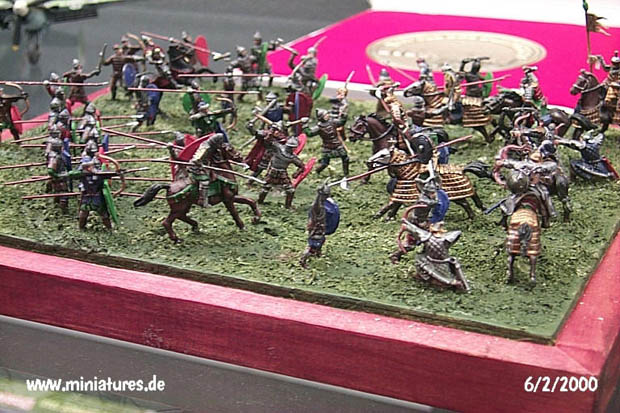
He was born just four years before the fierce Tatars, under the leadership of Ghengis Khan, came galloping across the steppes of Kievan Rus'.  The once flourishing city state--whose social, cultural and spiritual achievements boasted few rivals in Western Europe--had been weakened by quarrelling princes and attacks of warring tribes, and it was an easy prey for the massacring and pillaging Asiatic aggressors. Fortunately, the Mongol Horde's primary interest in conquest was financial gain, and although it imposed a heavy tax on its subjects, they were left to govern themselves and retained their traditions and religion intact, Nevertheless, the yoke of foreign sovereignty was
  burdensome; individual princes were reduced to acting as feudal landlords for their Mongol lords, and inclinations toward s national unity--the dream of Grand Prince Vladimir--were stifled. A strong leader was needed if the land of Rus' was to have any hope of healing internal strife, of throwing off the Tatar yoke, and establishing its identity as a nation state.
The once flourishing city state--whose social, cultural and spiritual achievements boasted few rivals in Western Europe--had been weakened by quarrelling princes and attacks of warring tribes, and it was an easy prey for the massacring and pillaging Asiatic aggressors. Fortunately, the Mongol Horde's primary interest in conquest was financial gain, and although it imposed a heavy tax on its subjects, they were left to govern themselves and retained their traditions and religion intact, Nevertheless, the yoke of foreign sovereignty was burdensome; individual princes were reduced to acting as feudal landlords for their Mongol lords, and inclinations toward s national unity--the dream of Grand Prince Vladimir--were stifled. A strong leader was needed if the land of Rus' was to have any hope of healing internal strife, of throwing off the Tatar yoke, and establishing its identity as a nation state. The baneful effect of internal dissension was a lesson which came early to Prince Alexander, as he witnessed his father, Prince Yaroslav Vsevolodovich, struggle with the proudly independent spirited boyars of Novgorod, It was there that the boy grew up. Like most noble youth s of his time, he had barely learned to walk before he was lifted into the saddle. Training in the martial arts was combined with an education based upon the Scriptures. Under the influence of his mother, who was popularly called "the holy queen" on account of her piety and charitable deeds, the young prince developed a profound spiritual life. He engrossed himself for hours in reading the Old and New Testaments.
He was still an adolescent when in 1236 his father became Grand Prince of Kiev (a position of primacy among the princes), leaving Alexander in charge of Novgorod. Its characteristically unruly citizenry was gradually won over by the uncommon wisdom and youthful charm of its new ruler. Meanwhile, the Tatars were moving north; they overran Ryazan, Moscow and the Russian capital of that time, Vladimir. They were prevented from reaching Novgorod only by the surrounding marshes. But the city was spared this disaster only to face a greater threat, this time from the west.
Encouraged by the Roman Pope who desired the conversion of Russia to Catholicism, the Swedes and Germans took advantage of Russia's weakened state and prepared to attack. As a staunch Orthodox Christian, Alexander recognized that conquest from the west would deal a mortal blow at the very heart of Russia—the Orthodox Church, a fate incomparably worse than political subjugation by the Tatars. In 1210, well armed Swedish troops moved onto Novgorod territory. Preparing his men to repel the invaders, St. Alexander encouraged them with his now famous affirmation: "God is not in might but in Truth. 'Some trust in princes and some in horses, but we will call upon the Lord our God.'" The Russian forces, their Prince in the lead, were crowned with success after a fierce battle on the shores of the Neva.
Victories followed against the Livonian Germans and the Lithuanians. The Russian north-east, devastated by the Tatars, looked with hope upon the young warrior prince. His fame reached the ears of the Mongol lord, Khan Batu, who desired to see this Russian hero. It was a perilous honor. Before being presented to the Khan, the Russian princes--whose authority depended on his approval--were required to fulfill certain pagan traditions: walk through fire, bow down to a bush and to the shadows of deceased khans, etc. Alexander would in nowise consent to such idolatry and, strengthened by Holy Unction, prepared himself to accept the death penalty which Prince Michael of Chernigov had paid under similar circumstances.
Arriving in the Golden Horde' s capital at the mouth of the Volga, Alexander at once confessed his Christian convictions: "O King," he said, bowing before the Khan, "I bow before you because God has favored you with authority, but I shall not bow before any created thing. I serve the One God. Him alone do I honor and Him alone do I worship." Khan Batu was so impressed by the courage and handsome demeanor of the young prince that to everyone's amazement he accepted his refusal and received him with due honor.
Gaining the respect of the Khan was a triumph for Alexander, but it did not insure peace. The remaining course of his life as Grand Prince of Russia was spent in securing its western borders against persistent German campaigns, in subduing the Novgorodians' defiant opposition to the Khan's poll tax, and in diplomatically placating the Khan’s anger which flared intermittently in response to indiscretions committed by the lesser princes. Although it was 200 years before Russia was free of Tatar control, St. Alexander’s skill and self-sacrificing devotion which he brought to the Herculean task set before him as ruler, and his commitment to the preservation of Orthodoxy at the core of a growing national consciousness, made him a hero of both historic and spiritual dimensions. He died as he was returning from one of his exhausting journeys to the Khan, having taken the Great Schema on his death bed. His respected spiritual advisor, Metropolitan Cyril, was serving the Divine Liturgy in Vladimir when he saw the Prince’s soul being carried aloft by angels and announced to those present: “Brethren, know that the sun of the Russian Land has now set.” In 1547 St. Alexander was glorified by the Church which celebrates his memory on the day of his repose, November 23, and the day of the translation of his incorrupt relics, August 30, 1724, to the St. Alexander Nevsky Lavra in St. Petersburg, where they rest to this day.



 brother of the Scottish King, began the siege of Stirling Castle,
  which was commanded by Sir Philip Mowbray. Unable to make any headway, Bruce agreed to a pact with
  Mowbray – if no relief came by midsummer 1314, the castle would surrender to Bruce. It was now two years since an English army had come to
  Scotland, and King Edward II of England had recently been on the verge of war with
  his barons after the murder of Piers Gaveston in the summer of 1312.
 According to the historian and poet John Barbour, KingRobert Bruce rebuked the folly of his brother, even though Dundee had probably fallen to the Scots through a
  similar arrangement in 1312. Mowbray had a breathing space and looked forward to the summer of 1314. In England, Edward and his barons reached an
  uneasy peace and made ready.Edward came to Scotland in the high summer of 1314 with the preliminary aim of relieving Stirling Castle: the real purpose, of course, was to find and destroy the Scottish army in the field, and thus end the war. England, for once, was largely united in this ambition, although some of Edward's greatest magnates and former enemies, headed by his cousin, Thomas of Lancaster
 , did not attend in person, sending the minimum number of troops they were required to by feudal law.
 on 17 June 1314 was impressive: it comprised between 2,000–3,000 horse (likely closer to 2,000) and 16,000 foot.
 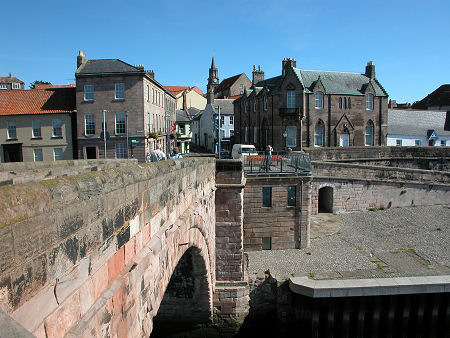 The precise size relative to the Scottish forces is unclear but estimates range from as much as at least two or
  three times the size of the army Bruce had been able to gather, to as little as only 50% larger.
 and veterans like
 Henry de Beaumont andRobert de Clifford, 1st Baron de Clifford. The most irreconcilable of Bruce's Scottish
  enemies also came: Ingram de Umfraville, a former Guardian of Scotland,
  and his kinsman the Earl of Angus, as well as others of the MacDougalls, MacCanns and Sir John Comyn of Badenoch
 , the only son of the Red Comyn, who was born and raised in England and was now returning to Scotland to avenge

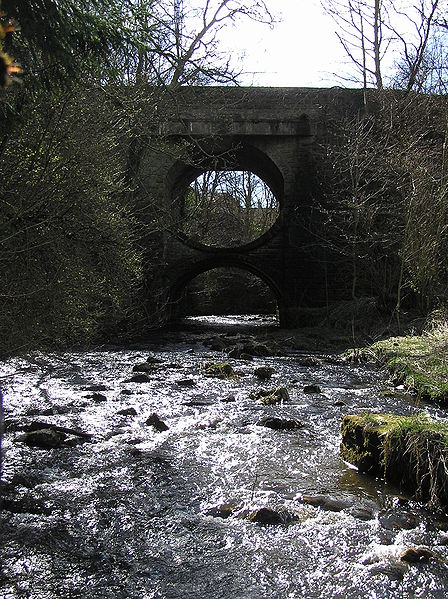 The English army marched rapidly to reach Stirling before Mowbray's agreement expired on 24 June. Edinburgh was reached on 19 June and by 22 June, it was at Falkirk
 , only 15 miles short of its objective. Edward's host followed the line of the old Roman road, which ran through an ancient forest known as the Tor Wood,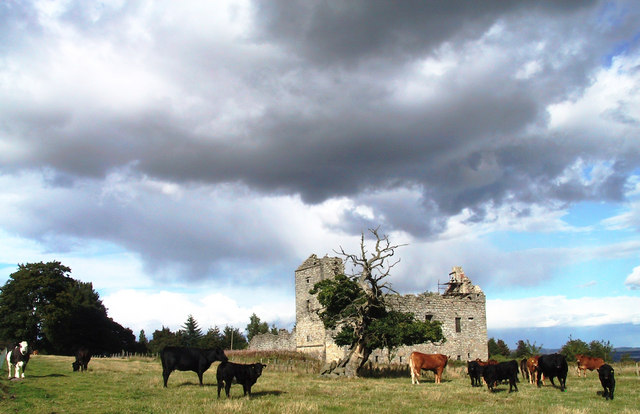


 divided into three main (infantry) formations, a force of light cavalry, and the camp followers (who took part at the end of the battle).


 Barbour tells that King Robert turned away those who were not adequately equipped. For most, such equipment would consist of a spear, a
 helmet, a thick padded jacket down to the knees and armoured gloves. It is highly probable that a large proportion of the spearmen had acquired more extensive armour given that the country had been at war for nearly twenty
  years. This is in contrast to the modern romantic notion of the Scots army, which depicts its foot soldiers clad in kilts, painted woad and little else. The balance of the army consisted of archers and men-at-arms.
 The Scottish archers used yew-stave longbows and it is not to be thought that they had weaker or inferior bows but rather had inferior numbers. Consisting of possibly only 500 archers,
 they played little part in the battle. There is first hand evidence from the captured Carmelite friar, Robert Baston in his poem, written just after the battle, that one or both sides employed slingers and crossbowmen.
 Each of these troop types was indistinguishable from their counterparts in France or England. Many of the Scottish men-at-arms (recruited from the nobility and the more prosperous burgesses) served on foot at Bannockburn.
 take risks, but these were always measured and calculated. He had no intention of chancing all on the outcome of a day, as had William Wallace at the Battle of Falkirk.
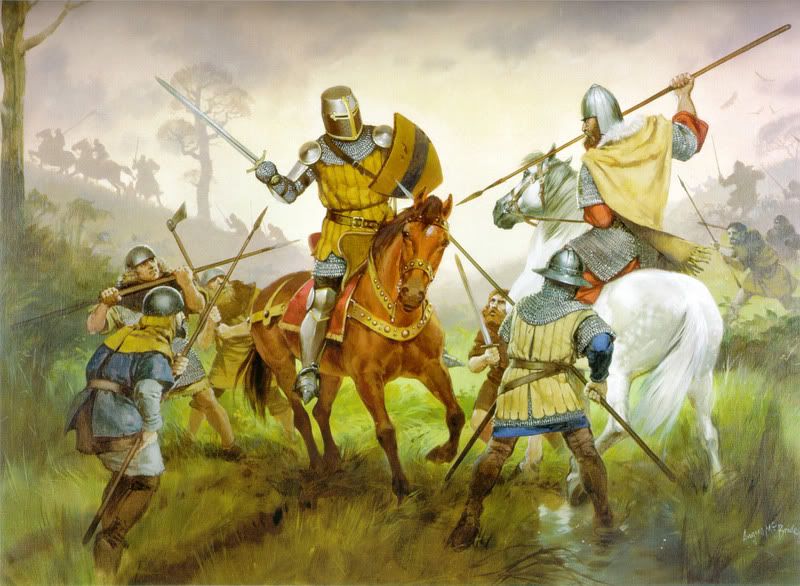
 The Scots army, again made up chiefly of spearmen as at Stirling, was arranged in four great armoured 'hedgehogs' known as schiltrons. The long spears pointed outwards at various heights gave these formations a
  formidable and impenetrable appearance. The gaps between the schiltrons were filled with archers and to the rear there was a small troop of men-at-arms, provided by the Comyns and other magnates.

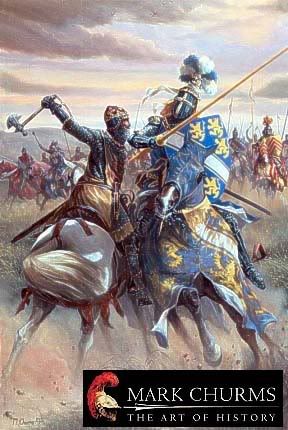



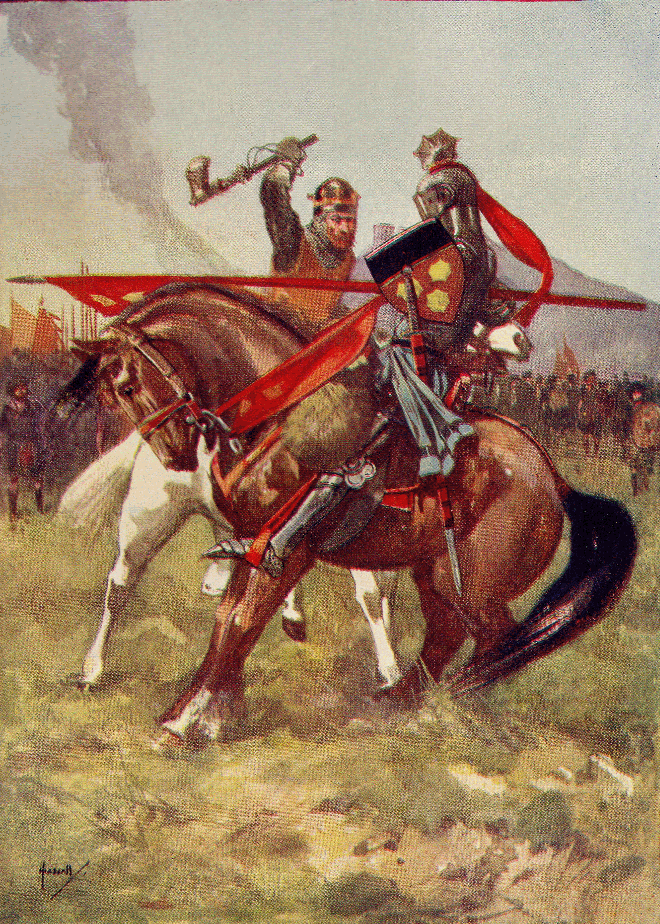
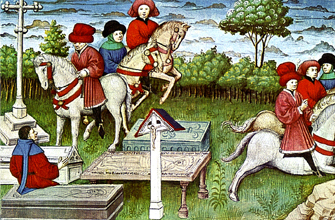 and armed only with a battle-axe.He had no armour on. As de Bohun's great war-horse thundered towards him, he stood his ground, watched with mounting anxiety by his own army. With the Englishman only feet away, Bruce turned aside, stood in his stirrups and hit the knight so hard with his axe that he split his helmet and head in two. This small incident became in a larger sense a symbol of the war itself: the one side heavily armed but lacking agility; the other highly mobile and open to opportunity. Rebuked by his commanders for the enormous risk he had taken, the king only expressed regret that he had broken the shaft of his axe.

 Not long after daybreak on 24 June, the Scots spearmen began to move towards the English. Edward was surprised to see Robert's army emerge from the cover of the woods. As Bruce's army drew nearer, they paused and knelt in prayer. Edward is supposed to have said in surprise "They pray for mercy!" "For mercy, yes," one of his attendants replied, "But from God, not you. These men will conquer or die."
 commanded by Edward Bruce. Gloucester, who according to some accounts had not bothered to don his
 d strength of the great army was beginning to work against the English king, as his army could not move quickly and lost a lot of time in getting into position.
 orable bloody push into the disorganised English mass, fighting side by side across a single front. Edward's
  army was now so tightly packed that if a man fell, he risked being immediately crushed underfoot or suffocated and the English and Welsh longbowmen failed to get a clear shot in fear they might hit their own men.
 After some time they moved to the side of Douglas's division and began shooting into its left, but upon the command of Robert the Bruce who foresaw this, the Scottish 500-horse light cavalry under the Marischal Sir Robert Keith dispersed them. The returning fleeing archers then caused the infantry itself to begin to flee. Later the knights began to escape back across the Bannockburn.
 this appeared to be a fresh reserve and they lost all hope. The English forces north of the Bannockburn broke into flight. Some tried to cross the River Forth where most drowned in the attempt.Others tried to get back across the Bannockburn, but as they ran, “tumbling one over the other” down the steep, slippery banks, a deadly crush ensued so that “men could pass dryshod upon the drowned bodies”.
 carnage of Bannockburn, the rest of the army tried to escape to the safety of the English border, ninety miles to the south. Many were killed by the pursuing Scottish army or by the inhabitants of the countryside that they passed through. Historian Peter Reese says that, "only one sizeable group of men—all footsoldiers—made
  good their escape to England. These were a force of Welsh spearmen who were kept together by their commander, Sir Maurice de Berkeley, and the majority of them reached Carlisle.Weighing up the available evidence, Reese concludes that "it seems doubtful if even a third of the footsoldiers returned to England."Out of 16,000 infantrymen, this would give a total of about 11,000 killed. The English chronicler Thomas Walsingham gave the number of English men-at-arms who were killed as 700, while 500 more men-at-arms were spared for ransom. The Scottish losses appear to have been comparatively light, with only two knights among those killed.
 The monument, and the associated visitor centre, is one of the most popular tourist attractions in the area.The Scottish victory was complete and, although full English recognition of

 national anthem Flower of Scotland refers to Scotland's victory over Edward and the English at Bannockburn.