
Showing posts with label ATLANTIC. Show all posts
Showing posts with label ATLANTIC. Show all posts
Tuesday, 31 January 2012


Monday, 30 January 2012
Thursday, 20 October 2011
The Badlands
 Phantly Roy Bean, Jr. (c. 1825 – March 16, 1903) was an eccentric U.S. saloon-keeper and Justice of the Peace in Val Verde County,Texas, who called himself "The Law West of the Pecos".
 According to legend, Judge Roy Bean held court in his saloon along the Rio Grandein a desolate stretch of the Chihuahuan Desert of southwest Texas
 . After his death, Western films and books cast him as a hanging judge, though he is known to have sentenced only two men to hang, one of whom escaped.
Roy Bean was born in 1825 in Mason County, Kentucky, 
the youngest of five (four sons and a daughter) of Phantly Roy Bean, Sr., and the former Anna Henderson Gore. The family was extremely poor, and at age sixteen Bean left home to ride a flatboat to New Orleans and possible work. After getting into trouble there, Bean fled to San Antonio, Texas to join his older brother Sam.
the youngest of five (four sons and a daughter) of Phantly Roy Bean, Sr., and the former Anna Henderson Gore. The family was extremely poor, and at age sixteen Bean left home to ride a flatboat to New Orleans and possible work.
After getting into trouble there, Bean fled to San Antonio, Texas to join his older brother Sam.
Samuel Gore "Sam" Bean (1819-1903), who had earlier migrated to Independence, Missouri, was a teamster and bullwhacker. He hauled freight to Santa Fe and then on to Chihuahua, Mexico. After Sam fought in the Mexican–American War, he freighted out of San Antonio, where Roy joined him.
In 1848, the two brothers opened a trading post in the Mexican state of Chihuahua. Soon after, Roy Bean shot and killed a Mexican desperado who had threatened "to kill a gringo." To escape being charged with murder by Mexican authorities, Roy and Sam Bean fled west to Sonora. By the spring of 1849, Bean had moved to San Diego, California, to live with his older brother Joshua. The older Bean was elected the first mayor of the city the following year.
Considered handsome, Roy Bean competed for the attentions of various local girls. A Scotsman named Collins challenged Bean to a pistol-shooting match on horseback. Bean was left to choose the targets, and decided that they would shoot at each other. The duel was fought on February 24, 1852, ending with Collins' receiving a wound to his right arm.
Both men were arrested and charged with assault with intent to murder. In the two months that he was in jail, Bean received many gifts of flowers, food, wine, and cigars from ladies in San Diego.
His final gift included knives encased in tamales. Bean used the knives to dig through the cell wall. After escaping on April 17, Bean moved to San Gabriel, California,
 where he became a bartender for his brother's saloon, known as the Headquarters Saloon. After Joshua was murdered in November, Bean inherited the saloon.
Both men were arrested and charged with assault with intent to murder. In the two months that he was in jail, Bean received many gifts of flowers, food, wine, and cigars from ladies in San Diego.
His final gift included knives encased in tamales.
Bean used the knives to dig through the cell wall. After escaping on April 17, Bean moved to San Gabriel, California, where he became a bartender for his brother's saloon, known as the Headquarters Saloon. After Joshua was murdered in November, Bean inherited the saloon.In 1854, Bean courted a young lady, who was subsequently kidnapped and forced to marry a Mexican officer. Bean challenged the groom to a duel and killed him. Six of the dead man's friends put Bean on a horse and tied a noose around his head, then left him to hang. The horse did not bolt, and after the men left, the bride, who had been hiding behind a tree, cut the rope. Bean was left with a permanent rope burn on his neck and a permanent stiff neck.
Shortly after that, Bean chose to leave California and migrated to New Mexico to live with Sam. The latter had been elected the first sheriff of Doña Ana County.
In 1861 Samuel G. and Roy Bean operated a merchandise store and saloon on Main Street in Pinos Altos (just north of Silver City) in present-day Grant County, New Mexico. It advertised liquor and "a fine billiard table." A cannon belonging to Roy Bean sat in front of the store for show. It was used to repel an Apache assault on the town.
Shortly after that, Bean chose to leave California and migrated to New Mexico to live with Sam. The latter had been elected the first sheriff of Doña Ana County.
In 1861 Samuel G. and Roy Bean operated a merchandise store and saloon on Main Street in Pinos Altos (just north of Silver City) in present-day Grant County, New Mexico. It advertised liquor and "a fine billiard table." A cannon belonging to Roy Bean sat in front of the store for show. It was used to repel an Apache assault on the town.
During the Civil War, the Confederate Army invaded New Mexico. After the Battle of Glorieta Pass in March 1862, the Texans began retreating to San Antonio.  After first taking money from his brother's safe, Bean joined the retreating army.
  For the remainder of the war, he ran the blockade by hauling cotton from San Antonio to British ships off the coast at Matamoros, then returning with supplies
For the next twenty years, Bean lived in San Antonio, working nominally as a teamster. He attempted to run a firewood business, cutting down a neighbor's timber. He then tried to run a dairy business, but was soon caught watering down the milk, and later worked as a butcher, rustling unbranded cattle from other area ranchers.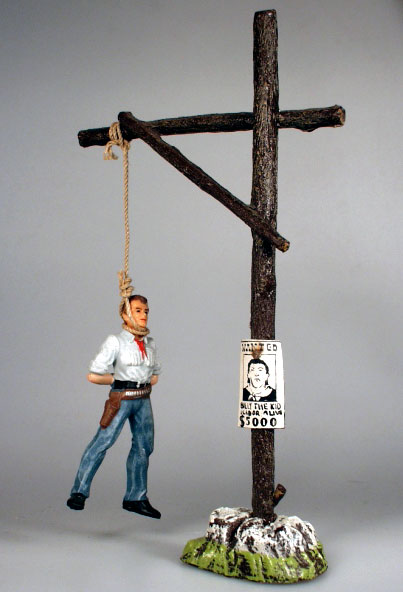
After first taking money from his brother's safe, Bean joined the retreating army. For the remainder of the war, he ran the blockade by hauling cotton from San Antonio to British ships off the coast at Matamoros, then returning with suppliesFor the next twenty years, Bean lived in San Antonio, working nominally as a teamster. He attempted to run a firewood business, cutting down a neighbor's timber. He then tried to run a dairy business, but was soon caught watering down the milk, and later worked as a butcher, rustling unbranded cattle from other area ranchers.
On October 28, 1866, he married eighteen-year-old Virginia Chavez. Within a year after they were married he was arrested for aggravated assault and threatening his wife's life.
Despite the tumultuous marriage, the two had four children together, Roy Jr., Laura, Zulema, and Sam.The family lived in "a poverty-stricken Mexican slum area called Beanville" (centered around the corner of South Flores Street and Glenn Avenue, not far from Burbank High School)
Despite the tumultuous marriage, the two had four children together, Roy Jr., Laura, Zulema, and Sam.The family lived in "a poverty-stricken Mexican slum area called Beanville" (centered around the corner of South Flores Street and Glenn Avenue, not far from Burbank High School)
By the late 1870s, Bean was operating a saloon in Beanville. Several railroad companies were working to extend the railroads west, and Bean heard that many construction  camps were opening.A store owner in Beanville "was so anxious to have this unscrupulous character out of the neighborhood" that she bought all of Bean's possessions for $900 so that he could leave San Antonio.
 pecos above
At the time, Bean and his wife were separated. Bean left his children with friends as he prepared to go west.With his earnings, Bean purchased a tent, some supplies to sell, and ten 55-gallon barrels of whiskey. By the spring of 1882, he had established a small saloon near the Pecos River in a tent city he named Vinegaroon. Within 20 miles (32 km) of the tent city were 8,000 railroad workers. The nearest court was 200 miles (320 km) away at Fort Stockton, and there was little means to stop illegal activity.
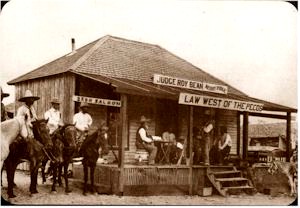 ATexas Ranger requested that a local law jurisdiction be set up in Vinegaroon, and on August 2, 1882 Bean was appointed Justice of the Peace for the new Precinct 6 in Pecos County. His first case had, however, been heard on 25 July 1882 when Texas Rangers brought him Joe Bell to be tried.
camps were opening.A store owner in Beanville "was so anxious to have this unscrupulous character out of the neighborhood" that she bought all of Bean's possessions for $900 so that he could leave San Antonio. pecos aboveAt the time, Bean and his wife were separated. Bean left his children with friends as he prepared to go west.
 With his earnings, Bean purchased a tent, some supplies to sell, and ten 55-gallon barrels of whiskey. By the spring of 1882, he had established a small saloon near the Pecos River in a tent city he named Vinegaroon. Within 20 miles (32 km) of the tent city were 8,000 railroad workers. The nearest court was 200 miles (320 km) away at Fort Stockton, and there was little means to stop illegal activity. ATexas Ranger requested that a local law jurisdiction be set up in Vinegaroon, and on August 2, 1882 Bean was appointed Justice of the Peace for the new Precinct 6 in Pecos County. His first case had, however, been heard on 25 July 1882 when Texas Rangers brought him Joe Bell to be tried.
As he aged, Bean spent much of his profits to help the poor of the area, and always made sure that the schoolhouse had free firewood in winter. He died March 16, 1903, peacefully in his bed, after a bout of heavy drinking in San Antonio over the building of a new power plant. He and a son, Sam Bean {1874-1907} are interred at the Whitehead Memorial Museum in Del Rio.
Tuesday, 21 June 2011



Monday, 30 May 2011


Wednesday, 13 April 2011

Thursday, 20 May 2010

Wednesday, 7 April 2010
300
 The 300 Spartans is a 1962 Cinemascope film depicting the Battle of Thermopylae. Made with the cooperation of the Greek government, it was shot in the village of Perachora in the Peloponnese. It starred Richard Egan as the Spartan king Leonidas, Ralph Richardson as Themistocles of Athens and David Farrar as Persian king Xerxes, with Diane Baker as Ellas and Barry Coe as Phylon providing the requisite romantic element in the film. In the film, a force of Greek warriors led by 300 Spartans fights against a Persian army of almost limitless size. Despite the odds, the Spartans will not flee or surrender, even if it means their deaths.
When it was released in 1962, critics saw the movie as a commentary on the Cold War,[1] referring to the independent Greek states as "the only stronghold of freedom remaining in the then known world", holding out against the Persian "slave empire".Xerxes I of Persia leads a vast army of soldiers into Europe to crush the small city-states of Greece to fulfill not only the idea of "one world ruled by one master", but also to avenge the defeat of his father, Darius I of Persia at the battle of Marathon 10 years earlier. Accompanying him are Artemisia I, the Queen of Halicarnassus who beguiles Xerxes with her feminine charm, and Demaratus, an exiled king of Sparta whose warnings Xerxes pays little heed toIn Corinth, Themistocles of Athens wins the support of the Greek allies and convinces both the delegates and the Spartan representative, Leonidas I, to grant Sparta leadership of their forces. Outside the hall, Leonidas and Themistocles agree to fortify the pass at Thermopylae until the rest of the army arrives. After this, Leonidas learns of the Persian advance and travels to Sparta to spread the news.
 View of the Thermopylae pass at the area of the Phocian Wall. In ancient times the coastline was where the modern road lies, or even closer to the mountain
In Sparta, fellow king Leotychidas is fighting a losing battle with the Ephors over a festival that is due to take place, and that the army should wait until after the festival is over to march, by which time the Persians will have conquered Greece. Leonidas secretly decides to take his personal bodyguard of 300 men to the pass, who are exempt from the decisions of the Ephors and the Gerousia. They are reinforced by Thespians led by Demophilus and other Greek allies.

After days of fighting, Xerxes grows angry as his army is "slaughtered like sheep" by the Greeks, with the Spartans in the forefront. Leonidas further pressures his men after receiving word that the remainder of the Spartan army will only fortify the isthmus in the Peloponnese and will advance no further. The Greeks constantly beat back the Persians, and Xerxes begins to consider withdrawing to Sardis until he can equip a larger force at a later date. Just then, he receives word from Ephialtes of a goat-track through the mountains. Rewarding Ephialtes greatly, Xerxes sends his army onward.

Thursday, 28 January 2010
MILESTONES


If Toy soldier collecting ever becomes intellectualised then that will come about from certain milestone production that goes beyond some middle aged drips playing with Fisher Price pirate boats in the bath. The Atlantic company of Italy produced maybe the most visionistic set of soldiers maybe ever done.
These communists of Mao were very unusual and if we think of the amount of times a really adventurous subject has been done then we are left with the Atlantic company and hardly anyone else.
The other company that has done something like this is KING AND COUNTRY with their Gestapo set but that didn't go down well with the TOY SOLDIER Magazine , the same magazine that accepts ads saying "Napalm , I love the smell of Napalm in the morning". How many young children were burnt by Napalm in Nam. That was really offensive but the Gestapo thing was just a straight retelling of the real events of World War Two. The Toy Soldier Magazine offered no return of opinion when I called their bluff on this crap. Their critique of King and Country was totally Hip hop as in IP-O-Crit-Ti-KALL dude.
But there you go, I've never known would be moralists who were truly moral.

The Nazi, Mao. The Russian revolution. another great moment by Atlantic
Wednesday, 27 January 2010
ATLANTIC

Monday, 25 January 2010

Thursday, 3 December 2009
ATLANTIC
This Atlantic Space series was quite interesting and allowed the buyer to create some fun wargames in Space

The Greeks.One of the best from the Atlantic firm.They were much more adventurous than anyone in the Plastic field.You should collect atlantic now because pretty soon they will be priceless gems


Subscribe to:
Posts (Atom)