 I found these timpo type soldiers in a shop by chance in their old box, they are for sale, mint.They are not Timpo though, I think they are Cherilea.
Showing posts with label medieval. Show all posts
Showing posts with label medieval. Show all posts
Sunday, 19 February 2012
Shop find
I found these timpo type soldiers in a shop by chance in their old box, they are for sale, mint.They are not Timpo though, I think they are Cherilea.

Sunday, 18 December 2011
bowmen
 An experienced longbowman would fire at about six arrows a minute, therefore in five minutes he would fire off around 30 arrows.
  In practice they could fire even
  faster but the strains and the draw weight would cause injuries to even the most
 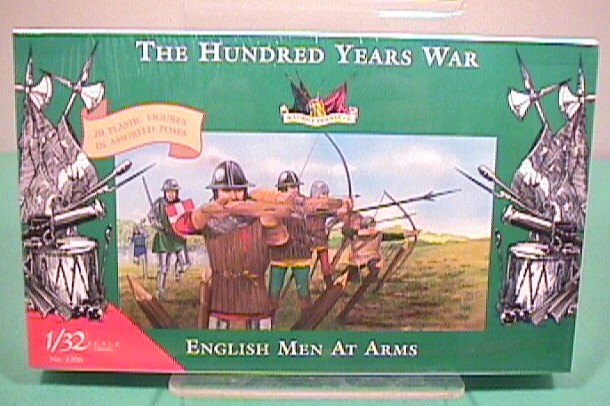 experienced bowmen, a sort of medieval repetitive strain injury.
 It was estimated that medieval bowmen were drawing at around 90 to 110lbs, with some estimates suggesting that the draw-weight was as much as 150-160 lbs.
 By comparison modern longbows are about 60 lbs, despite modern man being stronger, taller and heavier.
  This is because archers in the medieval era would be trained as boys with the bows getting progressively heavier as they got older.
Crossbowmen would fire at just less than half the speed of a longbowman, but the bolts or quarrels could
 punch a hole in all but the thickest armour and they were more accurarate
Friday, 15 July 2011
THE CROSSBOW versus the bow
 The crossbow played an important role in the late Medieval period. The crossbow was really the first hand-held weapon that could be used by an untrained soldier to injure or kill a knight in plate armour. The most powerful crossbows could penetrate armour and kill at 200 yards.
  Crossbows are easier to aim than longbows because the crossbowman doesn't have to use a hand to hold the string back while aiming. On a similar note, a crossbow can be loaded long before the bowman might need to shoot. In this way, the bowman would be able to shoot immediately if surprised. Crossbows require less upper body strength to operate as well. One can use both arms to span (draw back) a crossbow. Crossbows do, of course, come with a price. That price is in efficiency and in the firing rate.
 No bow is perfectly efficient, but Medieval crossbows were particularly inefficient. The reason for this is that the draw length and the lathe (also called a prod) of crossbows are short. So even though a crossbow may have a great deal of stored energy when spanned, the tips of the lathe do not have enough time to reach the maximum velocity, so the amount of stored energy is not transferred fully to the bolt. It is the lathe tip velocity that determines the speed of the bolt th
 The English lowbowmen were something like today's power lifters. After many years of frequent practice a power lifter's skeleton modifies and he can handle more weight. Similarly the medieval longbowmen had skeletal deformities from their lifelong archer practice with extremely stiff bows. Modern archers can't draw reproductions of medieval longbows - they are not strong enough.
The French nevEr dveloped their own longbowmen largely for rasons of social contol. Th English longbowmen asserted their rights because they were armed. The French were wary of the under classes being empowered. At Crecy and Poitiers they employed Genoese croSsbowmen mercenaries who posed less of a social threat.

 The key to understanding the different social attitude toward archers of the English and the French may be experienced in the famous St. Crispin speech in Henry the Fifth.
"We few, we happy few, we band of brothers;
For he to-day that sheds his blood with me
Shall be my brother; be he ne'er so vile,

". It is inconcievable for a French knight of the time to consider anyone of the lower class (infantry or archer) as a brother. Their whole society was build on the strongest class distinctions.
At Crecy the French knights rode down their own archers (who shot some of them) because they held them in contempt as mercenaries and non-noble. The English cared for their archers who were valued and respected as much as a commoner could be at the time.
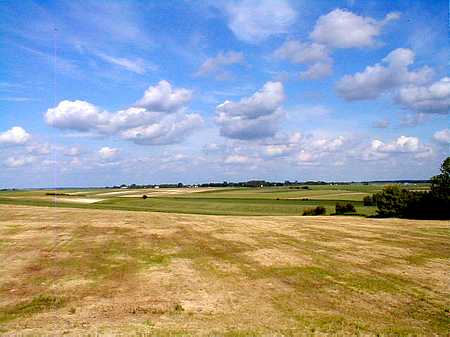 The French made the Genoese crossbowmen fight without their Pavises(shields) from too close to the English and they had to loose their weapons uphill. The crosbowmen also suffered from wet bow strings. The English longbow was easier to unstring and they had been able generally to keep their string dry.
The French at Crecy (and Poitiers) attacked too soon. They merely had to refuse battle for a day or so and the English would have had to move from their pre-pared poasitions. The crossbow string would be dry, the Genoese would have been able to fight on level ground and behind their big Pavises. The pavise was a large shield designed to protect crossbowmen while they reloaded their bows. It was made from wood, boiled leather and canvas and was decorated with coats-of-arms and pictures of saints. Rows of these highly-decorated shields would have been quite an awe-inspiring sight on the battlefield.

 The English crossbowmen unlike the Genoese wore no armor and had no shield. The Genoese could crouch behind the shield and weather the English arrows as they did in a castle under seige. The longbowmen had to stand upright and weather the crossbow quarrels as best they could. Longbowmen were very vulnerable to enemy missles.
The longbow might loose five times as many arrows per unit of time but grat difference in defensive equipment probably would have given the advantage to the crossbowmen.We'll never know because the French never used the crossbowmen properly at Crecy (or Poitiers). After all the French went into battle even before their own large infantry had arrived. They threw away all their advantages. If the battle had started with a real duel between crossbowmen and longbowmen where the crossbowmen weren't crippled by the stupidity of the French knights they might still have lsot but they would have thinned the ranks of the longbowmen and that might have been enough. The Hundred Year's War would have been over almost at the beginning.As it was the Fench learned nothing and repeated all their mistakes again and again at Poitiers and Agincourt.at is loosed.
A lthough there are working examples of Medieval crossbows, there are no working examples of Medieval longbows, so a direct comparison between the two cannot be made. Hence, the only data I can draw on for longbows is either from historical evidence or from reproductions of Medieval longbows. It is my belief that while the range of longbows changed very little from the 11th. century through Medieval times, the range of crossbows certainly did increase. Historical evidence would indicate that in the hands of a well-trained longbowmen, distances of 250-350 yards were commonly attained. A few modern archers have regularly achieved distances of 350-450 yards with reproduction longbows. Inigo Simot loosed an arrow 462 yards 9 inches in 1914, and there is a claim of someone loosing an arrow 482 yards with a longbow.
At the time of the battle of Crecy (1346 C.E.), the English longbow almost certainly had a greater range than the crossbow used in field combat.
 Throughout the Medieval Period though, crossbows became more powerful. Sir Ralph Payne-Gallwey loosed a bolt from an actual Medieval crossbow spanned with a cranequin and achieve a cast of 490 yards. The ordinary 15th. century crossbow would likely cast a bolt 370-380 yards. These crossbows would surely outperform almost any longbow in terms of distance, but the accuracy of the crossbow at those ranges would likely be poor at best.
With range out of the way, power is an even more difficult subject to breach. In general, arrows weigh more than bolts, so they have a larger momentum (force) associated with them. However, a late Medieval crossbow bolt has a higher speed associated with it, which will overcome the lower mass. (the the force being equal to the mass times the square of the velocity).
 Both longbows and crossbows were capable of penetrating all but the thickest plate maile armour, but my understanding is that the heavy crossbow was the main driving force leading to heavier and heavier plate maile armour. At point blank range, the crossbow almost certainly had greater penetrating power than a long bow.
  By the 15th century, and possibly earlier, it is safe to say that heavy crossbows (such as a windlass spanned crossbow) were more powerful than longbows. The common crossbow probably wasn't much more powerful Pope Innocent II in 1139 tried to ban this weapon as he thought it should not be used against Christian souls, yet it remained popular in most parts of Europe.
  The French used large numbers of mercenary crossbowmen, such as the Genoese, in their armies. In England it was mainly used for hunting and in castle defence. Its limitations were its slow rate of shot. A good crossbowman could shoot 3 arrows a minute, compared with the 12-15 arrows a minute of the longbow.though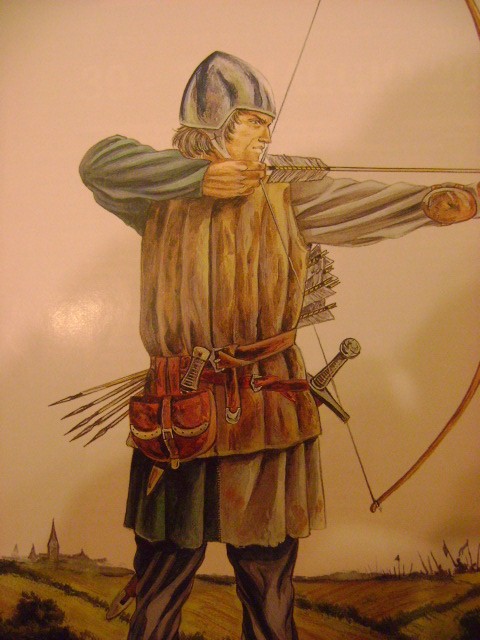
Sunday, 22 May 2011
battle of barnet by cherilea and crescent

The Battle of Barnet was a decisive engagement in the Wars of the Roses, a dynastic conflict of 15th-century England. The military action, along with the subsequent Battle of Tewkesbury, secured the throne for Edward IV. On 14 April 1471 near Barnet, then a small town north of London, Edward led the House of York in a fight against
 the House of Lancaster, which backed Henry VI for the throne. Leading the Lancastrian army was Richard Neville, 16th Earl of Warwick, who played a crucial role in the fate of each king. Historians regard the battle as one of the most important clashes in the Wars of the Roses, since it brought about a decisive turn in the fortunes of the two houses. Edward's victory was followed by fourteen years of Yorkist rule over England.
On 14 April 1471 near Barnet, then a small town north of London, Edward led the House of York in a fight against the House of Lancaster, which backed Henry VI for the throne. Leading the Lancastrian army was Richard Neville, 16th Earl of Warwick, who played a crucial role in the fate of each king. Historians regard the battle as one of the most important clashes in the Wars of the Roses, since it brought about a decisive turn in the fortunes of the two houses. Edward's victory was followed by fourteen years of Yorkist rule over England.Formerly a key figure in the Yorkist cause, Warwick defected to the Lancastrians over disagreements about Edward's nepotism, secret marriage, and foreign policy. Leading a Lancastrian army, the earl defeated his former allies, forcing Edward to flee to Burgundy. The Yorkist king persuaded his host, Charles the Bold, to help him regain the English throne.
Leading an army raised with Burgundian money, Edward launched his invasion of England, which culminated at the fields north of Barnet. Under cover of darkness, the Yorkists moved close to the Lancastrians, and clashed in a thick fog at dawn. While the main forces struggled in battle, John de Vere, 13th Earl of Oxford, and his Lancastrian troops routed the Yorkists under Lord William Hastings, chasing them up to Barnet.
  On their return to the battlefield, Oxford's men were erroneously shot at by his allies commanded by John Neville, 1st Marquess of Montagu. The Lancastrians lost the battle as cries of treason spread through their line, disrupting morale and causing many to abandon the fight. While retreating, Warwick was killed by Yorkist soldiers.
allies, forcing Edward to flee to Burgundy. The Yorkist king persuaded his host, Charles the Bold, to help him regain the English throne. Leading an army raised with Burgundian money, Edward launched his invasion of England, which culminated at the fields north of Barnet. Under cover of darkness, the Yorkists moved close to the Lancastrians, and clashed in a thick fog at dawn. While the main forces struggled in battle, John de Vere, 13th Earl of Oxford, and his
Lancastrian troops routed the Yorkists under Lord William Hastings, chasing them up to Barnet.  On their return to the battlefield, Oxford's men were erroneously shot at by his allies commanded by John Neville, 1st Marquess of Montagu. The Lancastrians lost the battle as cries of treason spread through their line, disrupting morale and causing many to abandon the fight. While retreating, Warwick was killed by Yorkist soldiers.
Warwick had been such an influential figure in 15th-century English politics that, on his death, no one matched him in terms of power and popularity. Deprived of Warwick's support, the Lancastrians suffered their final defeat at the Battle of Tewkesbury on 4 May 1471, which marked the downfall of the House of Lancaster and the ascendancy of the House of York. Three centuries after the Battle of Barnet, a stone obelisk was raised on the spot where Warwick purportedly died. Nick Clegg and fellow imbecile Cameron should heed the warning here.You may have to forgive thenm as if you chose to go to bed with a hideous fellow human being every night then you too may imagine yourself as a "Kingmaker" instead of the would be so called leader of a small country near Scandanavia.
For those who have only heard the term “kingmaker” recently and in connection with Nick Clegg, the name may suggest a divine and benevolent power.
Yet to those who know its medieval origins, it carries a hidden curse: that of Richard Neville, 16th earl of Warwick and foremost commander of the wars of the roses. Warwick tried to turn political stalemate to his personal advantage, and then, forced into breaking promise after promise, met a decidedly sticky end.
He earned his nickname for his part in making and breaking (and making again) the two dynasties that squabbled for control of England between about 1450 and 1485: the houses of Lancaster and York. Both of these had some claim to the throne, and when Warwick rose to prominence, the Lancastrians were ruling. They didn’t have the support of parliament, and their leader was possibly the most incompetent king ever to have ruled England: the hapless Henry VI, who owes his fame to the fact that he squandered the nation’s resources on grandiose projects while his soldiers suffered bitter defeat in the final days of the hundred years war.
The rebellious Warwick supported a pretender to the throne: his young cousin, Edward, earl of March. March’s father, the duke of York, had won what we might call a democratic mandate, in the form of support from parliament in 1460, but he had been murdered by his Lancastrian enemies only a few months later. Warwick hatched a plan to make good Edward’s inherited “mandate” while promoting his own interests at the same time. He cut a deal with the young earl, which led to an alliance of talent and manpower that toppled the Lancastrians in 1461. With the former Henry VI incarcerated in the Tower and most of his supporters dead, only his runaway queen, Margaret of Anjou, and their infant son, Edward of Westminster, had any right to dispute the claim of Edward IV to be king of England.
But the power Warwick had wanted for himself remained out of reach. The new king was simply too happy to rule without the assistance of his opportunistic cousin, since he believed his victory to have owed more to God and his own prowess than to the help of others. He even claimed there had been a miracle at one of his battles, where three suns had appeared on the horizon (an optical illusion known as a “parhelion”).
A disenchanted Warwick tried to replace Edward with a member of his own faction: the king’s younger brother, George, duke of Clarence. When this ploy failed, he shed all pretence of loyalty to York and decided that his interests were best served by bringing back the Lancastrians: he made overtures to the runaway Queen Margaret towards the end of 1470. To spectators this was a most unlikely of alliances, since the two parties were sworn enemies, both dripping with the blood of their respective friends and relations. But in the interests of power politics, then as much as now, even a pact with the devil was preferable to lonely obscurity.
For those who have only heard the term “kingmaker” recently and in connection with Nick Clegg, the name may suggest a divine and benevolent power.
Yet to those who know its medieval origins, it carries a hidden curse: that of Richard Neville, 16th earl of Warwick and foremost commander of the wars of the roses. Warwick tried to turn political stalemate to his personal advantage, and then, forced into breaking promise after promise, met a decidedly sticky end.
He earned his nickname for his part in making and breaking (and making again) the two dynasties that squabbled for control of England between about 1450 and 1485: the houses of Lancaster and York. Both of these had some claim to the throne, and when Warwick rose to prominence, the Lancastrians were ruling. They didn’t have the support of parliament, and their leader was possibly the most incompetent king ever to have ruled England: the hapless Henry VI, who owes his fame to the fact that he squandered the nation’s resources on grandiose projects while his soldiers suffered bitter defeat in the final days of the hundred years war.
The rebellious Warwick supported a pretender to the throne: his young cousin, Edward, earl of March. March’s father, the duke of York, had won what we might call a democratic mandate, in the form of support from parliament in 1460, but he had been murdered by his Lancastrian enemies only a few months later. Warwick hatched a plan to make good Edward’s inherited “mandate” while promoting his own interests at the same time. He cut a deal with the young earl, which led to an alliance of talent and manpower that toppled the Lancastrians in 1461. With the former Henry VI incarcerated in the Tower and most of his supporters dead, only his runaway queen, Margaret of Anjou, and their infant son, Edward of Westminster, had any right to dispute the claim of Edward IV to be king of England.
But the power Warwick had wanted for himself remained out of reach. The new king was simply too happy to rule without the assistance of his opportunistic cousin, since he believed his victory to have owed more to God and his own prowess than to the help of others. He even claimed there had been a miracle at one of his battles, where three suns had appeared on the horizon (an optical illusion known as a “parhelion”).
A disenchanted Warwick tried to replace Edward with a member of his own faction: the king’s younger brother, George, duke of Clarence. When this ploy failed, he shed all pretence of loyalty to York and decided that his interests were best served by bringing back the Lancastrians: he made overtures to the runaway Queen Margaret towards the end of 1470. To spectators this was a most unlikely of alliances, since the two parties were sworn enemies, both dripping with the blood of their respective friends and relations. But in the interests of power politics, then as much as now, even a pact with the devil was preferable to lonely obscurity.
Monday, 16 May 2011


Sunday, 27 March 2011

Subscribe to:
Posts (Atom)