

When the English Channel port of Boulogne fell to the Germans on May 25, 1940, the troops defending Calais a little to the north were the only line of defense between the German panzers and the remnants of the British Expeditionary Force (BEF), desperately hoping for evacuation from Dunkirk.
.jpg)
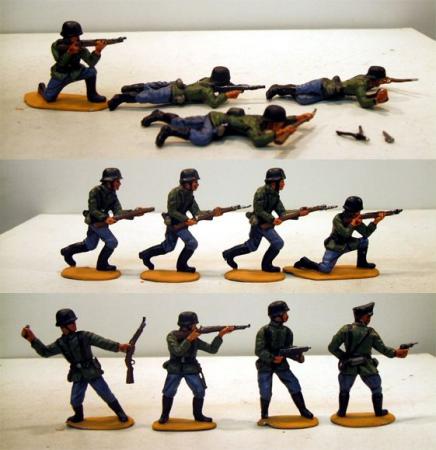 critical days, allowing the Allies to consolidate their hold on Dunkirk, but at the cost of the virtual destruction of the garrison.
During the period of the Phoney War Calais and the northern channel ports had been of little military significance. At the start of the war the British supplies lines stretched back to western France, partly because
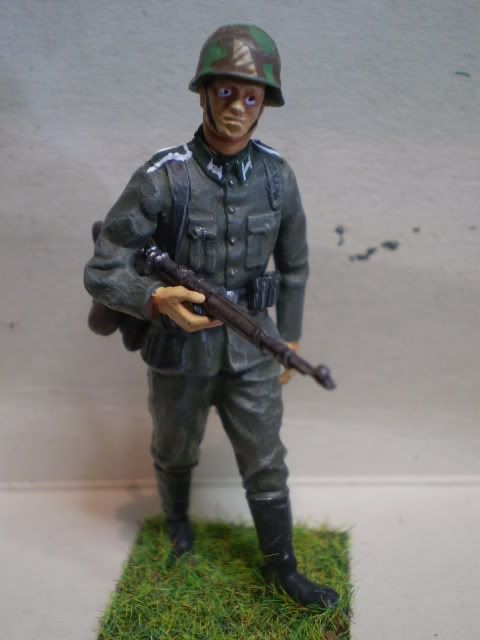
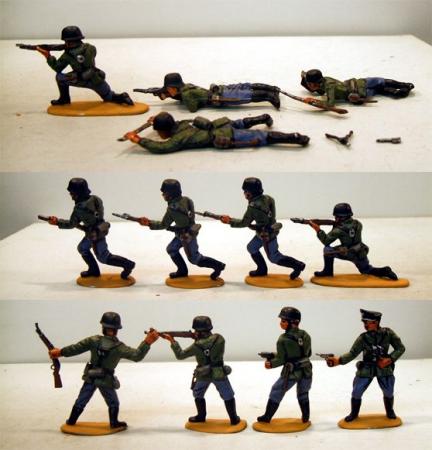 the French refused to allow the British to use Dunkirk, Calais or Boulogne for fear of provoking German air raids, although they had been used by large(German officer Bill Farmer)
numbers of men visiting Britain on leave. Under British pressure the French had slowly relented, but by the spring of 1940

Daily totals of men evacuated from Dunkirk.
| Date | From the beaches | From Dunkirk Harbour | Total | Running Total |
| Monday 27 May | 7,699 | 7,699 | 7,699 | |
| Tuesday 28 May | 5,930 | 11,874 | 17,804 | 25,473 |
| Wednesday 29 May | 13,752 | 33,558 | 47,310 | 72,783 |
| Thursday 30 May | 29,512 | 24,311 | 53,823 | 126,606 |
| Friday 31 May | 22,942 | 45,072 | 68,014 | 194,620 |
| Saturday 1 June | 17,348 | 47,081 | 64,429 | 259,049 |
| Sunday 2 June | 6,695 | 19,561 | 26,256 | 285,305 |
| Monday 3 June | 1,870 | 24,876 | 26,746 | 312,051 |
| Tuesday 4 June | 622 | 25,553 | 26,175 | 338,266 |
| Total | 98,671 | 239,555 | 338,226 |
On 20 May Lord Gort had ordered the evacuation of all non-essential personnel, and over the next few days 27,936 men had been evacuated from the continent.


Churchill wrote later, One has to eat and drink in war, but I could not help feeling physically sick as we afterwards sat silently at the table. As he did so, the defenders clung grimly to their positions, fighting until the following evening when their heroic resistance finally petered out. If one episode might be said to have permitted the miracle of Dunkirk to succeed, then it is probably the defense of Calais.

Calais had been used extensively throughout the so-called Phoney War period as a transit camp for men on compassionate leave. On May 20, Colonel R.T. Holland was appointed base commandant and ordered to arrange for the evacuation of useless mouths. At the same time, the anti-aircraft defenses were to be greatly improved and the 6th Heavy Anti-Aircraft Battery, Royal Artillery (RA), the 172nd Light Anti-Aircraft Battery, RA, and the 1st and 2nd Searchlight batteries were moved up from Arras and deployed in a semicircle around the town. Over the next four days, Holland began the process of evacuation on steamers from the Gare Maritime, while combat troops arrived on incoming vessels. In the meantime, he located some 150 noncombatants in the town, and a platoon of Argyll and Sutherland Highlanders was detailed to guard a Royal Air Force (RAF) radar station. There were also 1 1/2 French infantry companies based at Fort Risban, to the west, with two field guns at the citadel and a number of other French troops manning the coastal defenses.
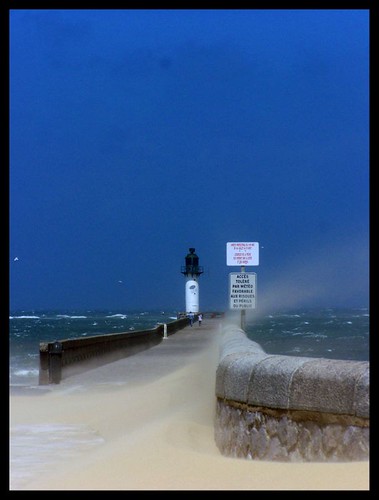
only Boulogne had come into regular use, while the main British supply lines still stretched back to ports west of the (BILL FARMER)Somme.
This all began to change after the start of the German campaign in the west. The German breakthrough at
Sedan on 14-15 May split the Allied armies in half, and when Guderian’s Panzers reached the coast at Abbeville on 20 May, the B.E.F.’s supply lines were cut. Suddenly Dunkirk, Calais and Boulogne became of critical importance. The true scale of the disaster had not 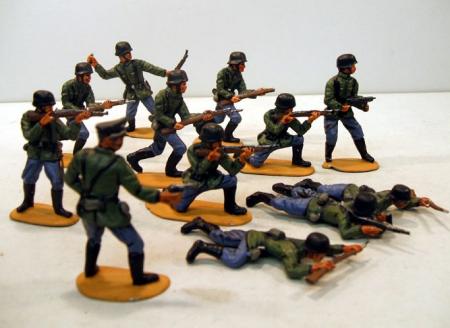 yet been realised, and so when the first troops landed at Calais, their mission was to establish a new supply line to the BEF, which was still fighting around Lille and Arras, over fifty miles inland. Plans were also put in place to use the three ports to evacuate the B.E.F. if necessary.
Brigadier Claude
Nicholson
 King’s Royal Rifle Corps (60th Rifles), the Queen Victoria Rifles and the Rifle Brigade, the 229th anti-tank battery of the Royal Artillery
800 French soldiers were also present in Calais, and would defend the citadel, a crucial part of the defences. This gave Nicholson a total of around 4,000 men.
After reaching the coast on 20 May, the Germans stopped for a day. When they began to move north on 22 May, the 10th Panzer Division was given the task of taking Calais, while the 1st Panzer Division was sent towards Dunkirk, with orders to make an attempt to capture Calais on the way past. At full strength each of these divisions contained somewhat over
 15,000 men and at least 300 tanks, although on 23 May General Kleist, the commander of the armoured spearhead of the German attack would report that half of his tanks were out of action. Even so, the British and French at Calais would be outnumbered by at least three to one.
In 1940 the town of Calais was still contained within a line of bastions and ramparts. These had been modified after the Franco-Prussian War, but by 1940 this work was over sixty years old. Nicholson soon realised that he would be unable to hold this outer perimeter for long. He decided to make his main stand on an inner perimeter, which covered the northern
 part of Calais, including the old town, the docks and the citadel. This was a shorter line, and much of it was protected by water lines, in the canals that run through Calais and in the docks themselves.
 22 May
The first elements of Calais Force, the Queen Victoria’s Rifles and the Tank Battalion, arrived in the port on 22 May and began to prepare for action. At this point the British were concentrating on preparing to link up with the forces at Dunkirk, and the creation of new supply lines for the B.E.F.

23 May
On the morning of 23 May the British in Calais still did not realise quite how close the Germans actually were. Elements of I Panzer Division had been ordered to make an attempt to capture Calais on their way towards Dunkirk, and by mid-morning columns
 of German tanks were approaching from the south west. Early in the morning patrols from the Queen Victoria’s Rifles were sent out to find the Germans, but they were perhaps rather too successful, for none returned.
Later in the morning three squadrons of tanks under Lt.-Colonel Keller left Calais, heading for St. Omer, twenty miles to the south east. At Guines, only five miles south of Calais, they ran into the German columns, advancing east from Marquise, and a short battle took place. Although the British tanks eventually retreated north to Coquelles, south west of Calais, this first German attack had been repulsed. I Panzer Division moved on, leaving X Panzer Division to deal with the defenders of Calais.

The day also saw the troops from the King’s Royal Rifle Corps (60th Rifles) and the Rifle Brigade land on the dunes east of Calais, and Brigadier Nicholson reach Coquelles, to prepare to make the attempt to open communications with Dunkirk.
24 May

That attempt began at 2 a.m. on 24 May. It was made by one squadron of tanks and a company from the Rifle Brigade, but soon ran into strong German forces on the road to Dunkirk. Brigadier Nicholson,
 who was accompanying the attack, was soon forced to call it off. The British pulled back into Calais, and prepared to defend the outer perimeter.

The Citadel, Calais, 1940

 the 10th Panzer Division concentrated on sealing off Calais, and did not carry out a systematic attack until the next day. This is almost certainly not how the defenders of Calais saw things. Fighting broke out all around the outer perimeter. By 6 p.m. the Germans had broken through the outer perimeter, and Brigadier Nicholson was forced to move his headquarters from the Boulevard Léon Gambetta to the Gare Maritime, on the waterfront.
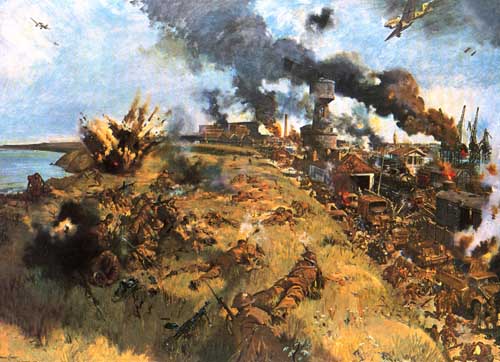
Artillery support for the defenders was provided by destroyers of the Royal Navy, along with the Polish warship Burza. These ships made a valuable contribution to the defence of Calais, but the coast was heavy – HMS Wessex was sunk, while HMS Vimiera and the Burza were both damaged. Later in the day HMS Wolfhound and HMS Verity made a trip into Calais, carrying supplies of ammunition, and Vice Admiral J. F. Somerville.

Somerville was able to meet with Nicholson, who gave him a summary of the British position. His men were short of ammunition. He only had two anti-tank guns and two light anti-aircraft guns left. On his return to Britain, Somerville would make a broadcast describing this meeting.

Early in the day the navy began to prepare to evacuate the troops at Calais, but this move did not meet with Churchill’s approval. By now he was coming to the conclusion that the force at Calais would have to fight on for as long as possible, to win time for the B.E.F. to reach Dunkirk, although the final decision would not be made until the following day.

25 May
X Panzer Division made a systematic attack on the inner perimeter during 25 May. By now the inner perimeter was made up of a series of separate posts, which could provide supporting fire, but were otherwise isolated. Despite this the Riflemen were able to hold of the German attacks for the entire day. In mid-
 afternoon Brigadier Nicholson moved his headquarters for one final time, this time to the citadel, where on the following day he would be captured.
At 9pm, after dinner, Churchill, Eden and Ironside finally decided not to evacuate the troops at Calais. Churchill recorded



feeling physically sick after making this decision, one of his first really hard decisions. The following signal was sent to Nicholson that night, although it is not certain that he ever received it.
Every hour you continue to exist is of the greatest help to the B.E.F. Government has therefore decided you must continue to fight. Have greatest possible admiration for your splendid stand. Evacuation will not(

repeat not) take place, and craft required for above purposes are to return to Dover. Verity and Windsor to cover Commander Mine-sweeping and his retirement.Despite this final decision, Admiral Ramsey decided to make a small fleet available in case the circumstances changed again. On the night of 25-26 May a flotilla of small ships made their way into the harbour, rescuing

 the wounded and the survivors of the Royal Marine detachment sent to protect the naval demolition crews.
26 May

The Courgain, Calais
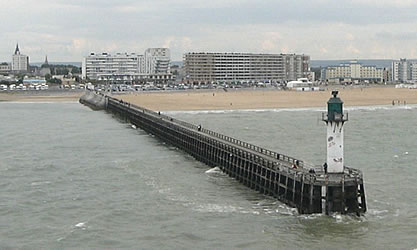
Even then the fighting did not end. British troops retreated into the Courgain, the fisherman’s quarter, and where they held on until 9 pm, when as darkness fell they were ordered to break up into small groups and make their own way out of the

town. By now there was little chance, and the majority fell into German hands.
The last British ship to visit Calais was the yacht Gulzar. She entered the harbour just after midnight, remaining until 1.00am on 27 May. She eventually picked up a part of 50 men from the end of the breakwater, and then made her way back to safety in Britain.
Conclusion
At the time the defence of Calais was seen as having been of vital importance. Calais was the last defended location before the Gravelines position, the western flank of the Dunkirk beachhead. According to this view, if Calais had not been held for as long as it was, then there would have been nothing to stop the Germans from sweeping into Dunkirk while the BEF was still engaged around Lille.
Since the war the importance of the defence of Calais has been constantly downplayed. Instead Hitler’s “halt order” of 24 May has been blamed for the German failure at Dunkirk. This forbade the German tanks from crossing a line running south from Gravelines, and remained in place for two days, before being lifted on 26 May. In the most extreme arguments, the defence of Calais has no significance at all. The post-war writing of the German generals is the main source used to support this viewpoint. This is always a dangerous line to follow – the German generals were generally unreliable witnesses, more concerned with the defence of their own records than with historical accuracy – Rundstedt’s denial of any part in the halt order is a classic example of this.

This argument does not stand up to closer examination. The first clashes at Calais took place on 23 May, the day before the halt order, and distracted I Panzer Division from the attack on Dunkirk. On 24 and 25 May, the two days of the halt order, Calais came under constant attack by the Luftwaffe, reducing the resources available to attack at Dunkirk.
British POWs, Calais
 still far from safety. The French position at Gravelines was increasing in strength, but the western flank of the corridor that the B.E.F. would have to use to reach Dunkirk was only defended by scattered units of the B.E.F
 . German troops had cross Hitler’s halt line at St Omer and Watten and were threatening the best road to Dunkirk. At least one German division was involved in the attack on Calais. If Churchill had pulled the British garrison out of Calais on the
night of 25-26 May then that division would have been available on 26 May when Hitler lifted the halt order. Finally, one should always remember that none of the Allied leaders knew about the halt order (something that some authors do seem to forget).
Ultimately it is impossible to be sure what might have happened on 26 May if the German troops that were engaged at Calais had been free to take part in the attack on the Dunkirk position,

 but what we do know is that without them the Germans failed to break through the lines being formed at Gravelines while they were at their weakest, a failure that allowed over 300,000 Allied troops to escape from the German trap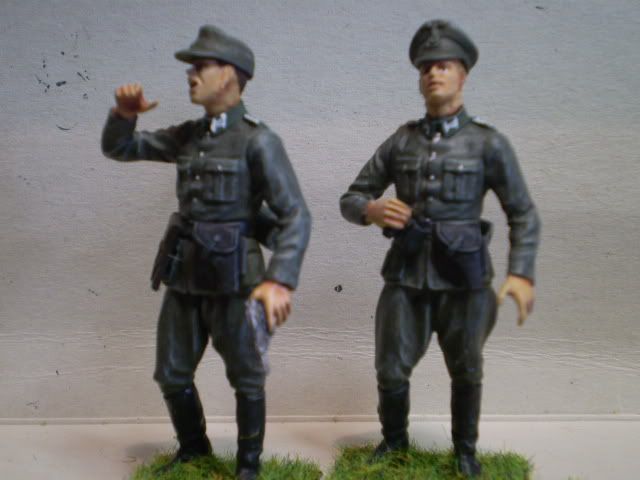


 (1429), with a possible version of his weapon -- a hand-held 'culverin'. The configuration shown here, incorporates an early 'matchlock' (Z-shaped) triggering lever. The end that lowered to a touch-hole on the barrel of the gun held a lit-match or hot coal, that ignited the charge inside the gun. The length of the narrow gun stock required suggests that it was braced beneath the gunner's arm. A shorter, thicker stock might have been use, and would have rested against the side of the gunner's upper arm. The heavy gun barrel rested in the cut-out at the top of the large shield. Such shields had their own support, or could be held by an assistant to the gunner.
  who was causing great harm to the French attackers at the gate to the compound. The gunner succeeded in striking the particular English warrior just before the French rushed and seized Les Augustins. One author summarizes the activities on the gunner, Jehan, who was a "phenomenal shot with the culverin," as follows: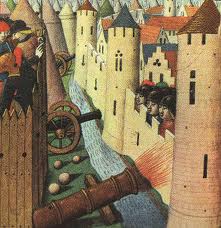

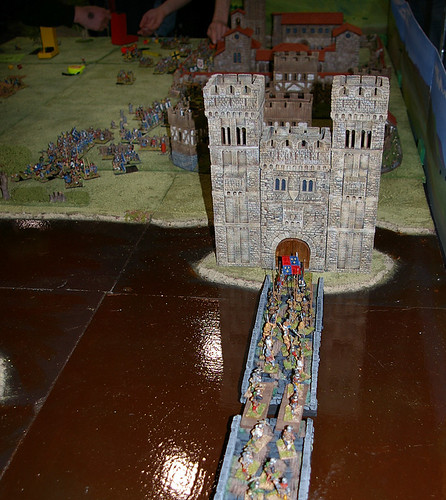 no larger than a human fist, but not a small lead shot. This, in turn, suggests a gun barrel of some caliber [diameter] -- slightly smaller than a modern infantry-carried mortar. Such a 'handgun' was probably too large [heavy] for a man to hold and aim without some assisted support for the gun. But certainly not so large that it could not be propped on a wall or large shield [pavise, used by crossbowmen]. Such a supported gun is an individual gun -- properly a 'hand-gun' or 'hand-cannon'.

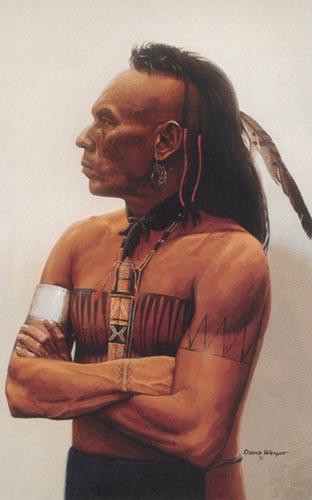

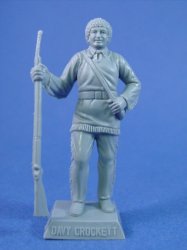
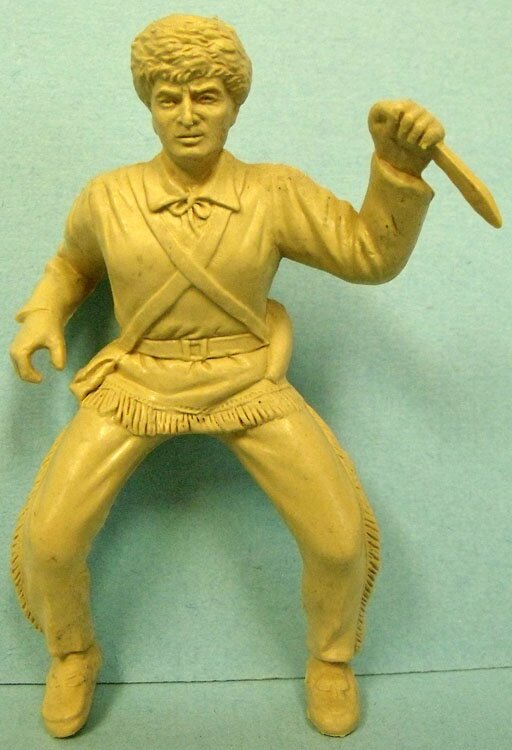
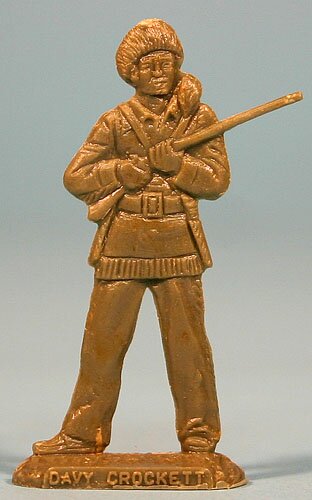
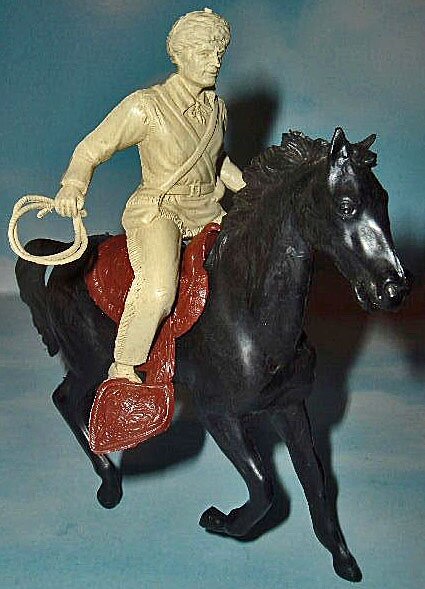
 By twelve years old he was bound out to a cattle drover from whom he had to escape through a snowstorm when the drover forcefully kept Davy past the end of his contract. Not having any luck with formal education, Crockett ran away from home at the age of thirteen in 1799.




![[image]](http://img.photobucket.com/albums/v291/Nefarioso/361836/mexsgt.jpg) The tail-coat shown above is the Model 1832 pattern. Fusileros also wore medium blue trousers with a red stripe. Footwear consisted of "brogans" (shoes) or sandals
The tail-coat shown above is the Model 1832 pattern. Fusileros also wore medium blue trousers with a red stripe. Footwear consisted of "brogans" (shoes) or sandals ![[image]](http://img.photobucket.com/albums/v291/Nefarioso/361836/heftermounted.jpg)
![[image]](http://img.photobucket.com/albums/v291/Nefarioso/361836/dragoon2.jpg) rifles, however, in most cases they were armed as were the Fusileros. The tailcoat shown above is the Model 1833, which is piped in green to indicate the wearer as being in the Cazadore Compania, They also wore "brogans" (shoes) or sandals and, for the most part, wore plain gray trousers.
rifles, however, in most cases they were armed as were the Fusileros. The tailcoat shown above is the Model 1833, which is piped in green to indicate the wearer as being in the Cazadore Compania, They also wore "brogans" (shoes) or sandals and, for the most part, wore plain gray trousers.![[image]](http://img.photobucket.com/albums/v291/Nefarioso/361836/dragoon.jpg)
![[image]](http://img.photobucket.com/albums/v291/Nefarioso/Alamo/soldado.jpg) caliber East India Pattern "Brown Bess" Rifles and their tailcoat, shown above, is also the Model 1833. They also wore "brogans" (shoes) or sandals and, by regulation, medium blue trousers with a red stripe
caliber East India Pattern "Brown Bess" Rifles and their tailcoat, shown above, is also the Model 1833. They also wore "brogans" (shoes) or sandals and, by regulation, medium blue trousers with a red stripe![[image]](http://img.photobucket.com/albums/v291/Nefarioso/Alamo/soldado2.jpg) .
. ![[image]](http://img.photobucket.com/albums/v291/Nefarioso/Alamo/soldado3.jpg) assault on the North Wall. Only some 180 of these troops were at the siege and no doubt "encouraged" the soldadoes
assault on the North Wall. Only some 180 of these troops were at the siege and no doubt "encouraged" the soldadoes ![[image]](http://img.photobucket.com/albums/v291/Nefarioso/Alamo/soldado4.jpg) forward with a little "prodding" at the point of a bayonet. Recent information indicates that some of the Zapadores wore
forward with a little "prodding" at the point of a bayonet. Recent information indicates that some of the Zapadores wore ![[image]](http://img.photobucket.com/albums/v291/Nefarioso/Alamo/soldado5.jpg) "barracks" caps, and white leather aprons, in lieu of the standard attire, and carried axes in order to chop through the adobe
"barracks" caps, and white leather aprons, in lieu of the standard attire, and carried axes in order to chop through the adobe![[image]](http://img.photobucket.com/albums/v291/Nefarioso/Alamo/soldado6.jpg) walls, at the northwest corner of Alamo, and in order to gain entry. Back of Tunic: Rear view of the tail-coat and barracks cap, the latter which was commonly worn by Zapadores (elite Mexican Sappers) during trenching operations and the final Alamo assault.
walls, at the northwest corner of Alamo, and in order to gain entry. Back of Tunic: Rear view of the tail-coat and barracks cap, the latter which was commonly worn by Zapadores (elite Mexican Sappers) during trenching operations and the final Alamo assault. ![[image]](http://img.photobucket.com/albums/v291/Nefarioso/Alamo/jensen1.jpg)
![[image]](http://img.photobucket.com/albums/v291/Nefarioso/Alamo/POFUNIFS.jpg)
 that Hollywood had portrayed them until recently. Neither were they more sadistic, more savage or more blood-thirsty
  then their Texas foe, as the latter so clearly proved at the battle of San Jacinto a couple of months after the Alamo siege. We can, and probably will, debate forever who was wrong and who
 was right during the Texas War of Independence. But through all of the arguments only one thing must remain perfectly clear if nothing else
  does. The Mexican Army was, arguably and undeniably, a professional army in their own right. They fought bravely and were committed to their "cause" no less heroically and with no less passion than the Texian defenders who opposed them from within the battered walls of the Alamo.The standard issue musket carried by the Mexican soldiers at the Alamo was the 3rd Model (East India Pattern) British "Brown Bess" smoothbore musket (above). Considered "surplus" by the British, these weapons were the primary weapon issued in Santa Anna's army and were of a 75-caliber with a length of 54 inches and a weight of about 9 pounds. The weapon also had a 15" long, socket bayonet that was secured to the weapon by the front sight blade. In the hands of an untrained soldier, it was difficult to hit a target passed about 50 yards and had a 40% misfire rate due to poor powder. These limitations, however, did not concern General Santa Anna, sinceaccuracy stood second to the deadly bayonet charge. The lack of marksmanship training, poor quality powder and the limited visibility in the pre-dawn darkness of 6 March 1836 may all have contributed to the weapons less than satisfactory performance during that chilly predawn assault. The Mexican Cazadores (Sharpshooters) are believed to have carried the Model 1806 British Baker Rifled Musket. It had a 30.5" barrel with a rifled .615 caliber bore consisting of seven square cut grooves which completed a mere quarter turn along the length of the barrel. A 22.5 inch short sword, which hooked on to the side of the barrel, served as a bayonet. It was in production from 1800 to 1838. Accurate to about 175 yards, it could be loaded while prone and was also sufficiently robust to take a bayonet and withstand the rigors of hand-to-hand combat during a lengthy period of service. Excavations, conducted south of the compound wall in February 1985 by archeologists from the University of Texas at San Antonio, revealed that Baker Rifle were used by some of the Mexican soldiers at the Alamo.